Men’s style in the 50s is often considered one of the most influential periods in modern fashion. The decade blended post war refinement with emerging youth culture, creating a balance between polished tailoring and rebellious edge. Structured suits, crisp shirts, leather jackets, and denim all became defining elements of the era.
Understanding men’s style in the 50s is essential for anyone who appreciates timeless tailoring, clean silhouettes, and confident dressing. Below at Bespoke CB, we break down the key elements that shaped this iconic decade and explain why they still influence modern wardrobes today.
Tailored Suits Defined the Decade
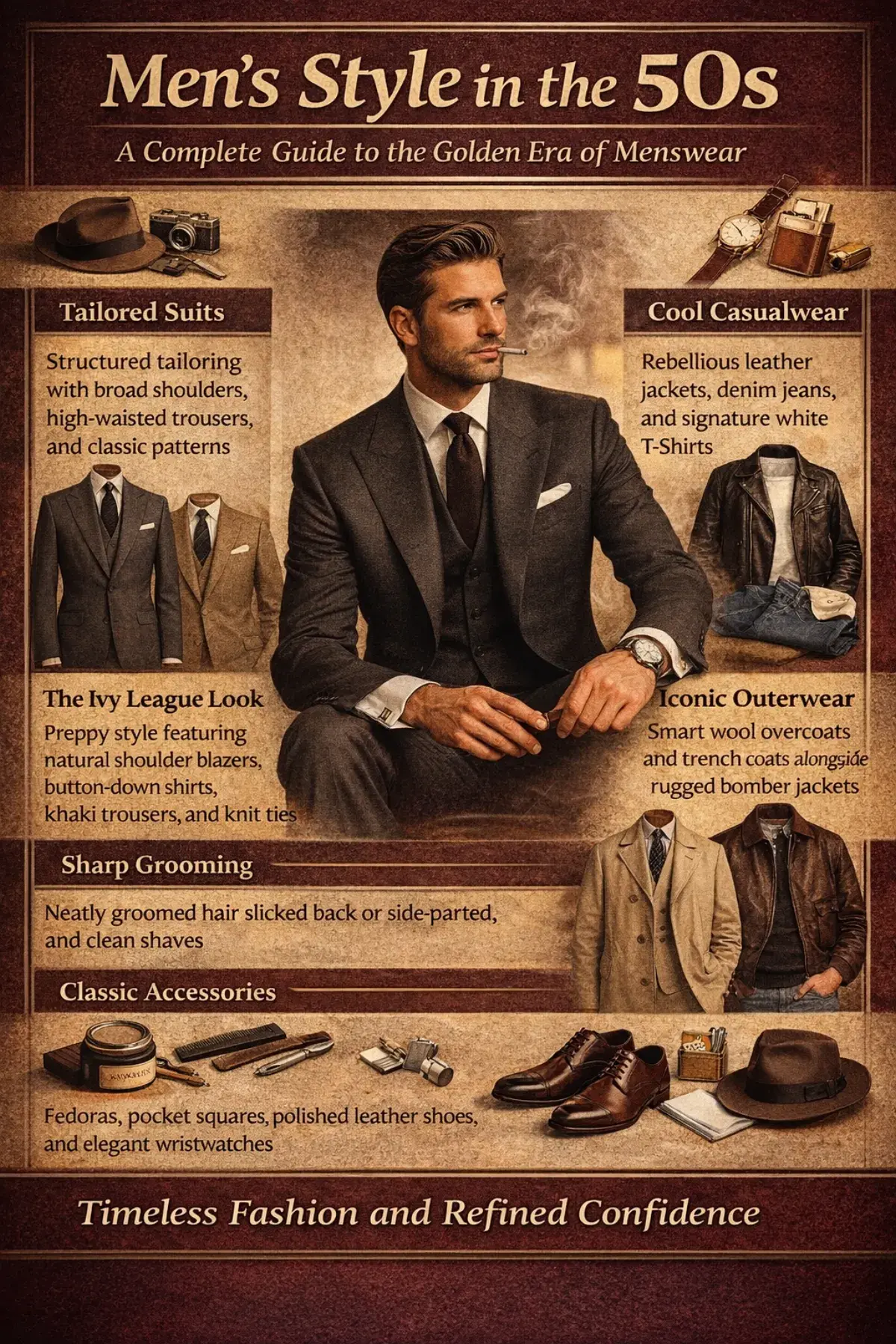
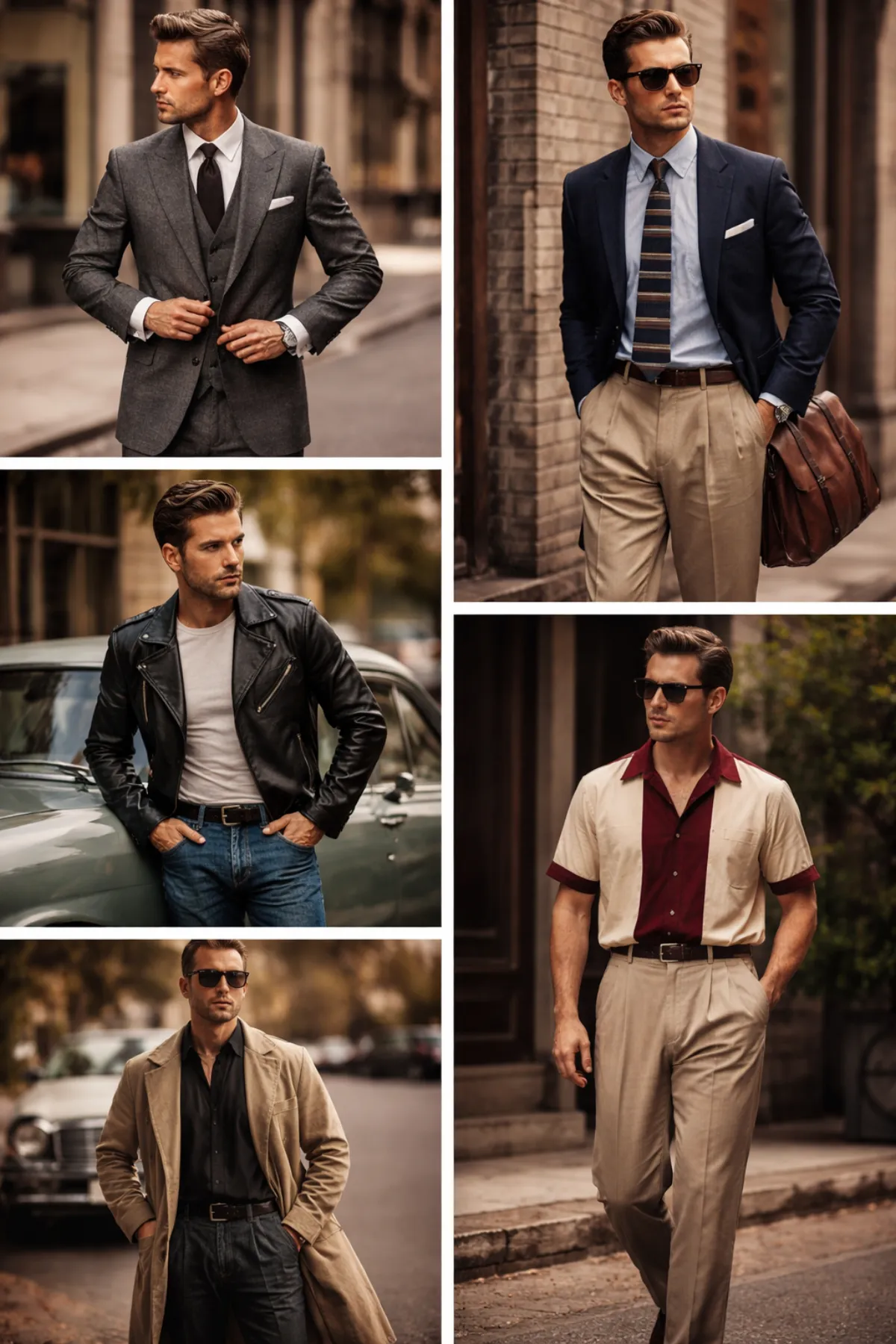
At the heart of men’s style in the 50s was structured tailoring. Suits were not optional for most professional or social settings. They were the standard.
Jackets featured strong shoulders, defined waists, and slightly longer lengths than many modern cuts. Trousers were typically high waisted with a clean drape and a fuller leg compared to today’s slim silhouettes. Fabrics like wool flannel and worsted wool were popular, offering both durability and structure.
Colors leaned conservative, with navy, charcoal, and medium grey dominating business wear. Patterns such as subtle pinstripes and windowpanes added sophistication without overwhelming the look. The overall impression was polished, masculine, and intentional.
This era established the blueprint for the power suit, emphasizing posture and proportion.
The Rise of the Ivy League Look
Men’s style in the 50s also introduced the Ivy League aesthetic, a cleaner and slightly more relaxed approach to dressing.
This style centered around natural shoulder jackets, slimmer lapels, and less padding than traditional tailoring. Button down oxford shirts became staples, often paired with knit ties or rep striped ties. Khaki trousers and loafers offered a collegiate alternative to formal suits.
The Ivy League look brought a youthful energy to men’s fashion without sacrificing refinement. It was understated, smart, and practical, making it a foundation for modern preppy style.
Casualwear Began to Evolve
While tailoring dominated formal settings, men’s style in the 50s marked a turning point for casual clothing. For the first time, off duty fashion began to define identity.
Denim jeans gained mainstream popularity, particularly among younger men. Paired with simple white t shirts or work shirts, denim symbolized rebellion and individuality. Leather jackets also became iconic, introducing a tougher aesthetic that contrasted sharply with traditional suiting.
This decade marked the beginning of casualwear as a meaningful expression of personal style rather than simply functional clothing.
Outerwear Made a Statement
Outerwear played a significant role in men’s style in the 50s. Structured topcoats, trench coats, and wool overcoats were essential layers for colder months.
The silhouette remained clean and tailored, often mirroring the shape of the suit underneath. Coats were designed to enhance the overall look rather than hide it.
At the same time, bomber jackets and shorter casual jackets gained popularity, particularly among younger men embracing emerging cultural shifts. This duality between refinement and rebellion defined the decade.
Grooming Was Part of the Style
Men’s style in the 50s extended beyond clothing. Grooming was equally important.
Hair was neatly styled, often slicked back or parted with precision. Clean shaves were standard in professional environments. Presentation was considered a reflection of discipline and respectability.
This emphasis on grooming reinforced the structured, intentional nature of the decade’s fashion.
Accessories Completed the Look
Accessories were never an afterthought in men’s style in the 50s. They were subtle but essential.
Hats such as fedoras and trilbies were still widely worn in the early part of the decade. Pocket squares added personality to tailored suits without overwhelming the look. Leather dress shoes, often cap toe or plain toe styles, were polished and well maintained.
Every detail contributed to a cohesive appearance. Nothing felt random or accidental.
Why Men’s Style in the 50s Still Influences Fashion Today
The reason men’s style in the 50s remains relevant is simple. It was built on proportion, quality, and confidence.
The decade mastered the balance between structure and ease. Tailored suits projected authority. Casualwear introduced personality. Grooming reinforced discipline. The overall result was a cohesive approach to dressing that felt both refined and authentic.
Many modern tailoring houses still draw inspiration from this era because its fundamentals never go out of style.
Key Fabrics and Textures of the 1950s
Fabric was the foundation of 1950s menswear, and the materials used then were substantially different from what most suits are made of today. Wool flannel was the heavyweight champion of the decade, prized for its soft hand, natural drape, and ability to hold a pressed crease through a full day of wear. Worsted wool, which is combed rather than carded, produced smoother and lighter suitings that held their shape beautifully in structured jackets. Gabardine, a tightly woven twill fabric, offered a distinctive diagonal texture and excellent durability, making it a favorite for both suits and trousers.
Warm weather fabrics were equally important in an era before air conditioning became universal. Seersucker, with its characteristic puckered weave, allowed air to circulate between the fabric and the skin, making it the default choice for summer wear in the American South. Hopsack, a coarse open-weave fabric, provided similar breathability with a more textured appearance. These fabrics were heavier and more substantial than their modern counterparts, which is partly why 1950s suits look so structured in photographs. The cloth had body and presence that thinner modern fabrics simply do not replicate.
The quality of these fabrics owed much to the mills that produced them. English mills in Yorkshire and Huddersfield supplied some of the finest worsteds and flannels in the world, while Italian mills in Biella began establishing their reputation for luxurious, lighter-weight suitings. These same regions remain the global center of quality menswear fabrics today, a testament to the enduring standards set during this period.
The Establishment vs. The Rebel: Two Sides of 1950s Style
Men's style in the 50s was defined by a cultural fault line that had never existed before. On one side stood the establishment look: sharp, structured suits in navy and grey, white dress shirts, polished oxfords, and fedoras. This was the uniform of Madison Avenue executives, bankers, lawyers, and anyone who aspired to the postwar American dream. The suit was armor. It signaled competence, reliability, and belonging. Think of the precursors to what would later become the Mad Men aesthetic, men who understood that dressing well was a professional obligation, not a personal indulgence.
On the other side emerged something entirely new: the rebel. Marlon Brando in The Wild One, James Dean in Rebel Without a Cause, and a young Elvis Presley created an anti-uniform that was the polar opposite of everything the establishment stood for. The leather motorcycle jacket, plain white t-shirt, cuffed denim jeans, and engineer boots became a deliberate rejection of conformity. This was the first time in modern history that youth culture split from adult fashion with such clarity. Teenagers and young men were no longer simply dressing like younger versions of their fathers. They were creating a visual identity that said we are not you, and the generation gap that would define the 1960s was already visible in the clothing of the 1950s.
What makes this duality so important is that both looks have survived. The establishment suit evolved into the business attire that dominated corporate culture for the rest of the century. The rebel look became the template for practically every youth subculture that followed, from rock and roll to punk to streetwear. The 1950s did not just give us two styles. It gave us the two archetypes that menswear has been remixing ever since.
Iconic 1950s Movie Style Moments
Hollywood in the 1950s was the most powerful style influence on American men, and the films of the decade produced iconic looks that are still referenced today. Cary Grant's wardrobe in Hitchcock's films, particularly North by Northwest and To Catch a Thief, set the standard for what a well-dressed man should look like. His suits were impeccably tailored, with a natural shoulder line and a clean drape that made every other man on screen look underdressed by comparison. Grant understood that the power of a suit is not in its details but in its fit, and his on-screen wardrobe proved it repeatedly.
Frank Sinatra brought a different energy to 1950s style. His suits were sharp but never stiff, paired with fedoras worn at a slight angle that suggested confidence without arrogance. Sinatra's style was less about perfection than about attitude. He made tailored clothing look effortless, which is the hardest thing to do. His combination of slim lapels, dark ties, and perfectly positioned pocket squares became a signature that men across the country tried to replicate.
The rebel side of 1950s cinema produced equally iconic moments. James Dean's red windbreaker and white t-shirt in Rebel Without a Cause became a uniform for disaffected youth, while Marlon Brando's leather jacket and Schott Perfecto in The Wild One established the motorcycle jacket as a permanent fixture in menswear. These were not costumes. They were character-defining choices that resonated because they felt authentic. Hollywood did not just reflect 1950s style. It shaped what everyday men aspired to wear, whether that was a Cary Grant suit or a Brando jacket.
1950s Shirt Collars, Ties, and Neckwear
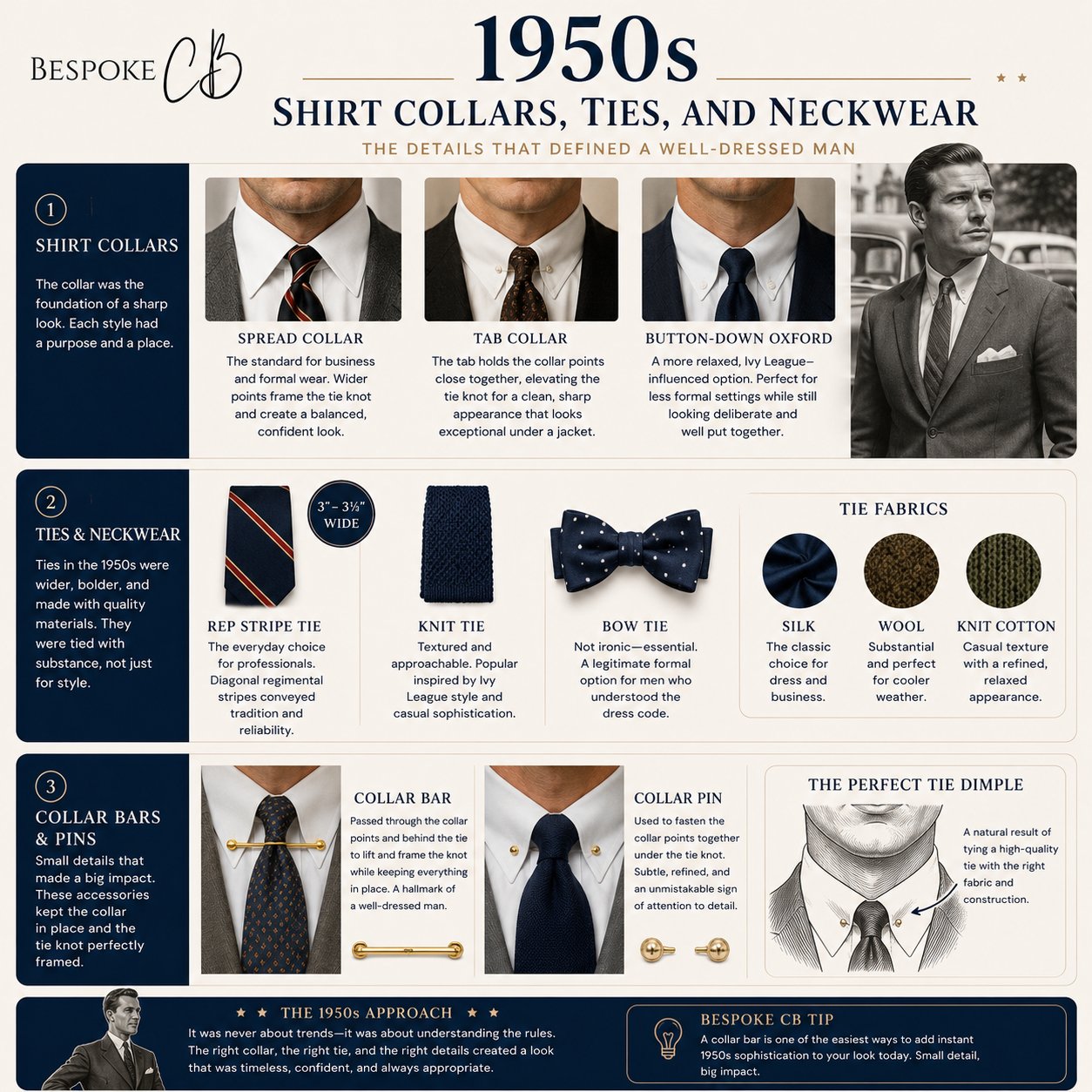
The details above the collar mattered enormously in 1950s menswear, and the collar itself was the starting point. Spread collars, which positioned the tie knot prominently between wider collar points, were the standard for business and formal wear. Tab collars, which used a small tab behind the tie to hold the collar points close together, created a clean, elevated tie knot that looked sharp under a jacket. Button-down oxford collars, borrowed from the Ivy League look, offered a more relaxed but still deliberate option for less formal occasions. Each collar style served a purpose, and men understood the difference.
Ties in the 1950s were wider than what most men wear today, typically measuring between three and three and a half inches at the widest point. Rep stripe ties, with their diagonal regimental patterns, were the everyday choice for professional settings. Knit ties, which offered a textured and slightly more casual alternative, gained popularity through the Ivy League influence. Bow ties were not ironic. They were a legitimate formal option worn by men who understood the dress code. The fabrics were silk, wool, or knit cotton, and the construction was substantial enough that a tie dimple was a natural result of tying, not a styling trick.
The collar bar and collar pin were small details that made a significant difference. A collar bar passed through the collar points and behind the tie, lifting and framing the tie knot while keeping the collar in place. It was a hallmark of a well-dressed man in the 1950s, a detail that separated those who understood the rules from those who simply followed them. Today, a collar bar is a rare sight, but it remains one of the most effective ways to add period-correct sophistication to a tailored outfit.
Shoes and Footwear of the 1950s
Footwear in the 1950s was governed by the same principles as the rest of the wardrobe: quality, structure, and purpose. Cap-toe oxfords in black or brown calf leather were the default business shoe, polished to a mirror shine and maintained with trees and regular conditioning. Plain-toe bluchers offered a slightly less formal alternative with a cleaner, more minimal appearance. Two-tone brogues, often called spectator shoes, made appearances at social occasions and country clubs, reflecting the decade's comfort with bold footwear that still operated within traditional rules.
The loafer emerged as one of the defining shoes of the 1950s, and it did so through two distinct paths. The penny loafer, with its saddle strap and slit designed to hold a penny, became a staple of the Ivy League look and crossed effortlessly from campus to office. The tassel loafer, introduced during this period, offered a dressier option that worked well with both suits and more relaxed trousers. Both styles were constructed from high-quality leather with leather soles, and both have remained in continuous production because they got the proportions right the first time.
On the casual side, saddle shoes with their distinctive two-tone leather panels became associated with both the Ivy League aesthetic and the emerging youth culture. Canvas sneakers, particularly those from Keds and Converse, began appearing outside of athletic contexts for the first time. The 1950s established the principle that a man needed more than one pair of shoes, and that each pair should be appropriate for its context. It is a principle that has not changed.
How to Incorporate 1950s Style Into a Modern Wardrobe
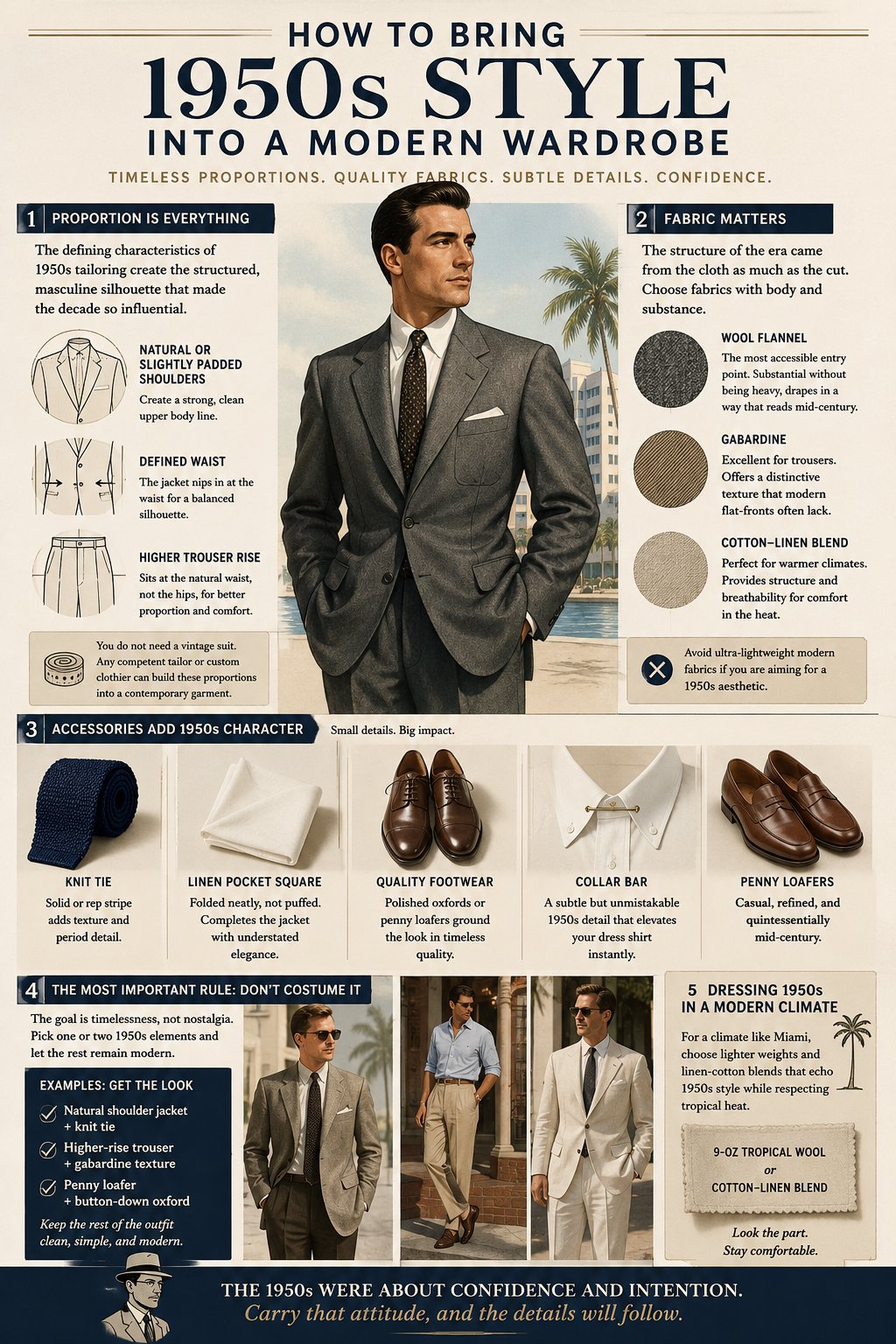
The most effective way to bring 1950s style into a modern wardrobe is to start with proportion. The defining characteristics of 1950s tailoring were natural or slightly padded shoulders, a defined waist, and a higher trouser rise that sat at the natural waist rather than the hips. These three elements alone will transform how a suit or sport coat looks on the body, creating the structured, masculine silhouette that made the decade's style so influential. You do not need a vintage suit to achieve this. Any competent tailor or custom clothier can build these proportions into a contemporary garment.
Fabric is the next consideration. Wool flannel is the most accessible entry point because it looks substantial without being heavy, and it drapes in a way that immediately reads as mid-century. Gabardine is another excellent choice, particularly for trousers, because it offers a distinctive texture that modern flat-front trousers often lack. For warmer climates, a cotton-linen blend with some body can approximate the structured look of 1950s fabrics while remaining comfortable in heat. Avoid ultra-lightweight modern fabrics if you are aiming for a 1950s aesthetic. The structure of the era came from the cloth as much as the cut.
Accessories are where you can add 1950s character without committing to a full vintage look. A knit tie in a solid color or a rep stripe adds texture and period detail to any outfit. A linen pocket square, folded neatly rather than puffed, completes a tailored jacket without looking theatrical. Polished leather oxfords or penny loafers ground the look in quality footwear. The collar bar, for those willing to try it, is a subtle but unmistakable 1950s detail that elevates a dress shirt immediately.
The most important rule is this: do not costume it. The goal is timelessness, not nostalgia. Pick one or two 1950s elements, a natural shoulder jacket with a knit tie, a higher-rise trouser with a gabardine texture, a penny loafer with a button-down oxford, and let the rest of the outfit remain modern. For a climate like Miami, where Bespoke CB is based, choose lighter weights and linen-cotton blends that echo the 1950s preference for substantial fabrics while respecting the reality of tropical heat. A 1950s-inspired suit in a 9-ounce tropical wool or a cotton-linen blend will look the part without making you miserable. The 1950s were about confidence and intention. Carry that attitude, and the details will follow.
Frequently Asked Questions
What did men wear in the 1950s?
Men in the 1950s wore structured suits with strong shoulders and defined waists for professional and social occasions. Casualwear included denim jeans, white t-shirts, leather jackets, and work shirts. The Ivy League look introduced button-down oxford shirts, khaki trousers, and loafers as a smart-casual alternative. Grooming was precise, with slicked-back hair and clean shaves being the standard.
What fabrics were popular in 1950s suits?
Wool flannel and worsted wool were the dominant suit fabrics of the 1950s. Gabardine was widely used for both suits and trousers due to its durability and diagonal texture. For warm weather, seersucker and hopsack provided breathability before air conditioning was common. These fabrics were heavier and more substantial than most modern suitings, which is why 1950s suits look so structured in photographs.
How did 1950s suits differ from modern suits?
1950s suits featured higher-waisted trousers, fuller legs, stronger shoulder padding, and longer jacket lengths than most modern suits. The overall silhouette was more structured and formal. Fabrics were heavier, lapels were wider, and the fit was built around proportion rather than the slim, body-hugging cuts that dominate contemporary tailoring. The 1950s suit was designed to project authority and presence, not to look effortless.
Were leather jackets popular in the 1950s?
Yes, leather jackets became iconic in the 1950s, largely through the influence of Marlon Brando in The Wild One and the emerging rock and roll culture. The leather motorcycle jacket, particularly the Schott Perfecto, became a symbol of rebellion and youth culture. It was the anti-uniform of the decade, worn with white t-shirts and cuffed denim jeans as a deliberate rejection of the establishment suit.
What shoes did men wear in the 1950s?
Cap-toe oxfords in black or brown leather were the standard business shoe. Plain-toe bluchers offered a slightly less formal option. The penny loafer and tassel loafer rose to prominence during the decade, driven by the Ivy League look. Saddle shoes were popular for casual and social occasions, while canvas sneakers from Keds and Converse began appearing outside of athletic contexts for the first time.
How can I dress in 1950s style today?
Start with proportion: choose jackets with natural shoulders and a defined waist, and trousers with a higher rise. Select 1950s-inspired fabrics like wool flannel or gabardine. Add period accessories such as knit ties, pocket squares, and polished leather oxfords or penny loafers. Avoid wearing a full vintage outfit, which can look like a costume. Instead, incorporate one or two 1950s elements into an otherwise modern wardrobe for a timeless, confident look.
What is the Ivy League look from the 1950s?
The Ivy League look was a distinctly American style that emerged on college campuses in the 1950s. It featured natural-shoulder jackets with minimal padding, button-down oxford shirts, knit or rep stripe ties, khaki trousers, and penny loafers. The aesthetic was understated and clean compared to traditional structured tailoring, and it became the foundation for what would later be known as preppy style. It offered a youthful, practical alternative to the formal business suit.
How much did a suit cost in the 1950s?
A quality men's suit in the 1950s typically cost between $50 and $100, depending on the fabric and the tailor. Adjusted for inflation, that equates to roughly $600 to $1,200 in today's dollars. Custom tailoring was more expensive but still more accessible than it is today, as off-the-rack clothing had not yet fully replaced made-to-measure as the default. A good suit was considered an investment, and men typically owned fewer of them than they do today, maintaining each one carefully.
Men's 1950's Style Inspiration
Men’s style in the 50s represents a defining moment in fashion history. It blended classic tailoring with emerging individuality, creating a foundation that continues to shape modern menswear.
Whether you are drawn to structured suits, Ivy League refinement, or rugged casual wear, the influence of the 1950s is unmistakable. Its legacy proves that great style is not about trends. It is about timeless principles executed with confidence.
Want to have a 1950's inspired custom made suit? Book your appointment today at Bespoke CB.
Every garment from Bespoke CB is constructed with full canvas interlining, hand-finished details, and premium fabric sourced from the finest mills in the world. These are not marketing claims. They are construction facts that produce a garment you can feel the difference in from the moment you put it on. The lapels roll naturally because the canvas has been hand-padded. The chest drapes cleanly because the construction moves with your body. The fit is precise because the pattern was drafted for you and only you.
What distinguishes Bespoke CB from other custom clothiers is not just the quality of the garments, though that quality is exceptional. It is the relationship between clothier and client. Christian takes the time to understand your lifestyle, your professional needs, your social calendar, and your personal style before recommending a single fabric or cut. The result is clothing that fits not just your body but your life, clothing that works seamlessly across every occasion and every season.
The bespoke process at Bespoke CB typically takes 4 to 6 weeks from initial consultation to final delivery. During that time, clients work directly with Christian and his team on fabric selection, construction details, and the iterative fitting process that ensures every dimension is correct. The experience is collaborative, educational, and genuinely enjoyable for men and women who take their appearance seriously.
Ready to experience the difference that bespoke clothing makes? Visit Bespoke CB to schedule your consultation with Christian Boehm. The full bespoke process takes 4 to 6 weeks and produces a garment that fits your body and your life in ways no off-the-rack option can match.