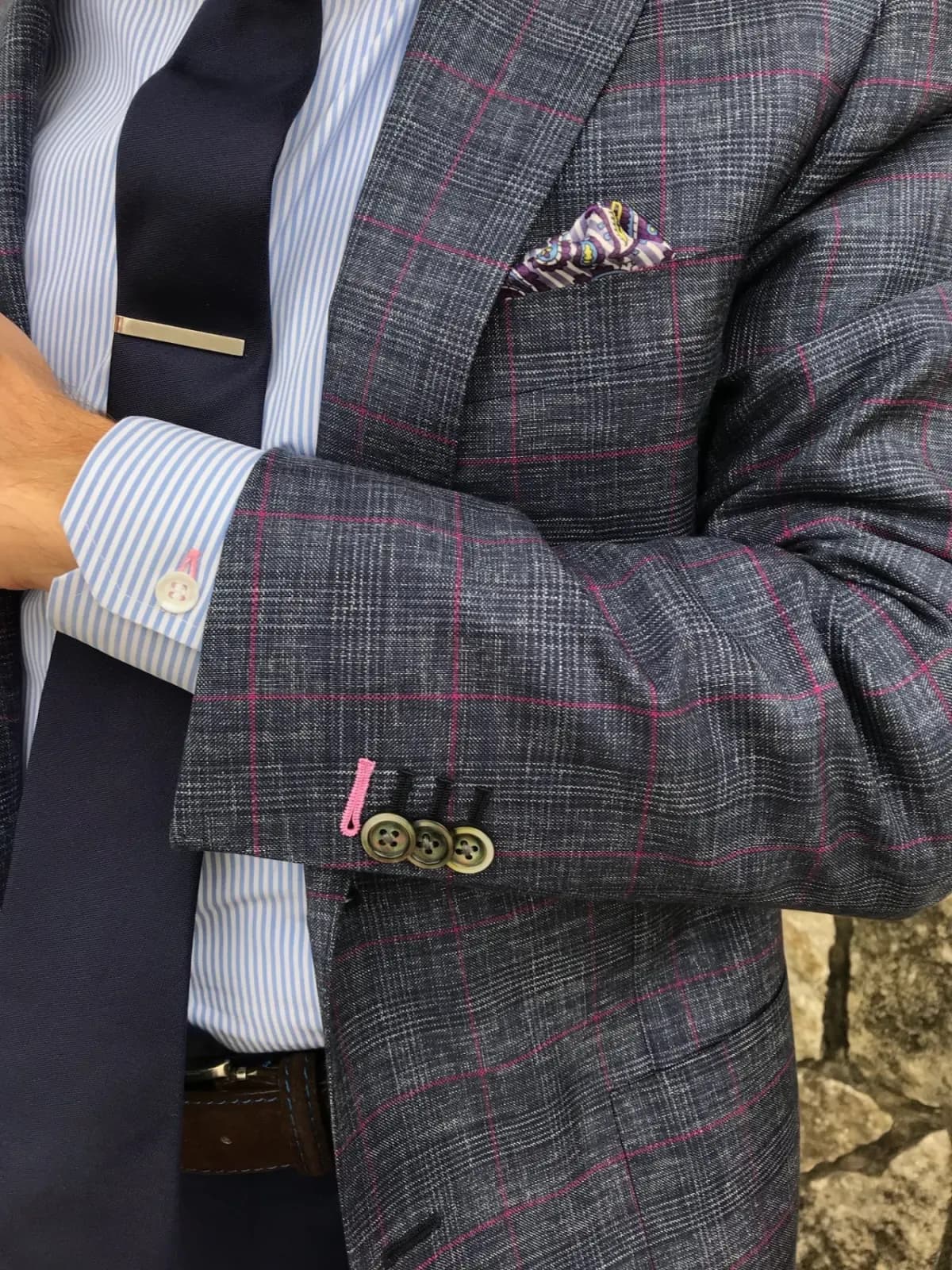
Why Off-the-Rack Clothing Fails So Many Men
If you have ever walked into a department store, tried on a dozen jackets, and walked out with nothing, you are not alone. The ready-to-wear industry designs clothing for a statistical average that very few men actually match. When your body does not conform to that average, the result is frustration: jackets that pull across the back, sleeves that hit at the wrong point, trousers that bunch or sag, and a silhouette that never looks quite right no matter how much you spend.
The truth is that off-the-rack clothing is designed for a body that does not exist. It is built around composite measurements drawn from population data, scaled up and down in set increments. If your shoulders slope more than the standard, if your arms are longer than average, if your torso-to-leg ratio is unusual, or if your build is anything other than mid-range, off-the-rack will always fight you.
Book a consultation with Bespoke By CB and experience what clothing designed for your actual body feels like. Or learn more about what makes us different from other custom clothing companies.
The Problem With Made-to-Measure for Hard-to-Fit Bodies
Many men who struggle with off-the-rack turn to made-to-measure, hoping for a better result. It is an improvement, but it still falls short for genuinely hard-to-fit bodies.
Here is why: made-to-measure starts with an existing block pattern and adjusts it. The tailor takes 10 to 15 measurements and modifies a standard template to approximate your body. If your body is close to the standard the block was designed for, the results can be decent. But if your body deviates significantly from that standard, the adjustments push the pattern beyond what it was designed to handle. The result is a garment that is better than off-the-rack but still not right.
True bespoke is fundamentally different. At Bespoke By CB, we draft every pattern from scratch using 34+ unique body measurements. Christian Boehm does not start with a template and modify it. He starts with a blank sheet of paper and builds a pattern around your actual body, accounting for posture, asymmetry, proportion, and every unique characteristic that makes you, you.
Read our complete guide to bespoke vs made-to-measure for a deeper look at the differences.
Hard-to-Fit Body Types and How Custom Clothing Solves Each One
1. Hunched Posture and Kyphosis (Hump Back)
Men with forward-rolled shoulders or a curved upper spine know the frustration all too well. Off-the-rack jackets pull tight across the upper back, the collar stands away from the neck creating an ugly gap, and fabric bunches behind the shoulders. No amount of alterations fixes it because the problem is in the pattern, not the sizing.
Custom clothing solves this by adjusting the pattern from the very beginning. Christian takes specific measurements of your forward shoulder position, the curve of your upper spine, and your natural neck angle. The pattern is then drafted with:
- Extra length through the back panel to accommodate the curve without pulling
- A modified collar height and angle so it sits flush against your neck
- Forward shoulder positioning in the sleeve attachment so the jacket moves with your body instead of against it
- Adjusted balance points so the jacket hangs cleanly rather than riding up
The result is a jacket that follows your natural posture instead of fighting it. No pulling, no gaps, no bunching. The fabric drapes smoothly because it was designed for your spine, not a mannequin's.
2. Sloping Shoulders
Sloping shoulders are one of the most common fit problems, and one of the most visible. When a jacket's shoulders do not match yours, you get divots, collapsed-looking shoulder lines, and a jacket that appears a size too big or too small even when the body fits. Off-the-rack jackets are built with a standard shoulder slope angle that assumes a relatively level shoulder line.
Custom tailoring addresses this directly in the pattern. The shoulder slope angle is measured precisely and built into the pattern from the start. Christian also adjusts:
- The shoulder padding thickness to create a clean line without looking overbuilt
- The sleeve head shape to follow your shoulder's natural contour
- The armhole height and width for unrestricted movement
- The relationship between the shoulder seam and the collar so everything sits in harmony
A client we will call Robert came to us after years of wearing jackets that made him look like he was shrinking. His shoulders sloped more than 15 degrees below the standard. Every off-the-rack jacket he owned had divots at the shoulders and a collapsed silhouette. After his first custom fitting, he told Christian it was the first time he had ever looked in a mirror and seen his shoulders look square and strong. That is what a pattern drafted from scratch can do.
3. Long or Short Arms
Sleeve length seems simple until it is wrong. Sleeves that are too short expose too much wrist and make you look like you outgrew your jacket. Sleeves that are too long bunch over your hands and look sloppy. Off-the-rack jackets set sleeve length based on chest size, which assumes that arm length correlates with torso size. For many men, it does not.
Custom clothing measures each arm independently. Yes, many men have arms that are slightly different lengths, and a pattern drafted from scratch accounts for that. Christian sets the sleeve length to show exactly the right amount of shirt cuff, typically a quarter to a half inch, based on your preference. The sleeve pitch, the angle at which the sleeve hangs from the shoulder, is also adjusted so the sleeve follows your arm's natural hang rather than twisting or pulling.
For men with especially long or short arms, the difference is transformative. No more rolling up sleeves that are too long. No more jackets that look like they belong to someone bigger. The sleeve hits exactly where it should because the pattern was built for your arms, not a chart's prediction of what your arms should be.
4. Long or Short Legs and Disproportionate Torso-to-Leg Ratio
Off-the-rack clothing assumes a standard ratio between torso and leg length. If your legs are longer or shorter than expected for your height, everything looks off. Jackets are too long or too short. Trousers have the wrong rise. The break at the shoe is never right.
Custom tailoring addresses proportion holistically. Christian measures your actual torso length, leg length, and the relationship between them. The pattern is then drafted with:
- Jacket length proportional to your actual body, not a height chart
- Trouser rise set for your natural waist position, not a standard measurement
- Break adjusted to your preference: full, half, or no break
- Button stance positioned to flatter your actual torso length
- Pocket placement scaled to your proportions so it does not look misplaced
A client we will call Marcus is 5'6" with a longer-than-average torso and shorter legs. Every off-the-rack jacket made him look shorter because the jacket length was proportional to his total height, not his torso. Christian adjusted the jacket length to his actual torso and raised the button stance to create a longer leg line. The transformation was immediate. Marcus looked taller, more balanced, and more proportional because his clothing was finally designed for his actual body.
5. Very Slim or Very Muscular Builds
The clothing industry's "average" is a myth. Off-the-rack is cut for a mid-range build that represents a statistical midpoint, not a real person. If you are 140 pounds with a narrow frame, everything fits too loose. If you are 280 pounds of muscle with a 48-inch chest and a 34-inch waist, everything fits too tight in the chest and too loose in the waist.
Custom clothing drafts the pattern around your actual measurements, whatever they are. For slim builds, Christian creates a pattern with appropriate reduction through the body, properly scaled lapels, and sleeves that do not look like they belong on a larger man. For muscular builds, the pattern accommodates the drop between chest and waist, adds room through the shoulders and arms for movement, and tapers cleanly through the body to show your shape without restriction.
The key is that nothing is forced. Off-the-rack tries to compress or expand a standard pattern to fit you. Custom builds the pattern around you from the start.
6. Big and Tall and Plus-Size Men
Off-the-rack big and tall clothing has a fundamental problem: it scales up a standard pattern without adjusting proportions. A size 48 jacket is often just a size 42 with everything enlarged by the same percentage. The lapels get too wide. The pockets end up in the wrong place. The button stance drops too low. The leg taper disappears. The result is clothing that technically fits your measurements but makes you look bigger than you are.
Custom tailoring scales proportionally. Christian adjusts every element of the pattern to create a balanced silhouette at any size:
- Lapel width scaled to your body, not just enlarged
- Pocket placement positioned for your actual chest and torso dimensions
- Button stance set at the right height to create a clean V-shape
- Leg taper adjusted to create a clean line without being restrictive
- Jacket length proportional to your height and build
- Shoulder width that creates structure without exaggeration
The goal is not to make you look smaller. The goal is to make you look sharp, balanced, and confident. Learn more about our big and tall custom tailoring and how we engineer garments around your body.
7. Amputees and Physical Disabilities
This is where custom clothing matters most, and where off-the-rack fails most completely.
Standard clothing assumes a symmetrical body with two arms, two legs, and standard range of motion. For amputees, prosthetic users, wheelchair users, and men with physical disabilities, off-the-rack is not just a poor fit. It is often impossible to wear.
Custom clothing can accommodate a wide range of physical differences with dignity and precision:
- Prosthetic limbs: Garment construction is adapted to fit over or around prosthetics. Sleeve shapes are modified for prosthetic arms. Leg shapes are adjusted for prosthetic legs. The pattern accounts for the difference in volume and shape between a natural limb and a prosthetic.
- Seated tailoring for wheelchair users: Jackets are cut with extra length in the back to account for sitting posture. Trousers are drafted with a higher back rise and adjusted front rise so they stay comfortable and properly positioned while seated. Waistbands are designed to avoid pressure points.
- One-sided body differences: Each side is measured and drafted independently. If one arm is shorter, the sleeve is shorter. If one shoulder is lower, the shoulder line adjusts. The garment looks balanced because the pattern compensates for the difference.
- One-handed closures and magnetic buttons: For men with limited dexterity or the use of one hand, closures can be adapted with magnetic buttons, hook-and-loop systems, or modified buttonhole positions that make dressing independently possible.
- Modified leg shapes: For men with leg differences, leg amputations, or prosthetic legs, trouser patterns are adjusted to accommodate the shape and volume of each leg individually.
- Limited mobility adaptations: Wider armholes, adjusted sleeve widths, and modified closures accommodate limited range of motion without sacrificing fit or appearance.
The psychological impact of clothing that fits cannot be overstated. For men with physical disabilities, clothing is often one more reminder of how their body differs from the norm. Custom clothing that is designed for their actual body, not a modified version of someone else's, restores dignity and confidence. It says: your body deserves to be well dressed. And it does.
Christian has worked with clients across the full spectrum of physical ability. His approach is always the same: listen, measure, and build a pattern that works for you. No pity, no awkwardness, just expert tailoring that produces clothing you are proud to wear.
8. Asymmetrical Bodies
Everyone is slightly asymmetrical. One shoulder is usually a quarter inch lower than the other. One arm is often slightly shorter. But for some men, the asymmetry is more dramatic, and off-the-rack clothing makes it obvious.
Custom tailoring measures each side of your body independently. Christian records measurements for your left and right shoulder, left and right arm, left and right side of your torso. The pattern is then drafted to compensate for the differences so the finished garment looks balanced and symmetrical even if your body is not.
This is something made-to-measure simply cannot do. A made-to-measure system takes a standard pattern and adjusts it by a few measurements. It cannot accommodate significant asymmetry because the base pattern assumes symmetry. Bespoke, with 34+ measurements taken independently across both sides of your body, can.
9. Post-Surgical Bodies
Surgery changes your body. Whether you are recovering from a procedure, living with a medical device, or managing a long-term condition, your clothing needs to work with your body as it is now, not as it was before.
Custom clothing can accommodate a range of post-surgical and medical needs:
- Port access: Hidden openings or modified construction allow access to ports for medical treatment without removing the garment.
- Compression needs: Garment construction can incorporate compression zones or accommodate compression garments worn underneath.
- Modified closures for medical devices: Buttons, zippers, or magnetic closures can be positioned to work around medical devices, drainage tubes, or bandaging.
- Adjusted fit for swelling or changes: If your body is still changing post-surgery, the pattern can accommodate current measurements with room for adjustment in future orders.
For men recovering from surgery or managing medical conditions, clothing that fits well is not a luxury. It is a part of feeling like yourself again.
Why 34+ Measurements Matter More for Hard-to-Fit Bodies
For a man with a standard build, 10 or 15 measurements might be enough to approximate a decent fit. The standard pattern is close enough that small adjustments work.
For a man whose body deviates from the standard, 10 or 15 measurements are not nearly enough. The pattern needs to account for differences that a standard measurement set does not even capture. Shoulder slope. Back curvature. The relationship between chest and waist. The angle of the neck. The position of the natural waist. The difference between left and right sides.
Christian's 34+ measurement process captures all of this and more. Each measurement is taken to build a complete picture of your body, not to plug numbers into a formula. The result is a pattern that reflects your actual shape, not an approximation of it.
See the full comparison of Bespoke By CB vs other custom suit companies and understand why more measurements means a better fit.
The Emotional Impact of Clothing That Finally Fits
We have had clients literally tear up during their first fitting. Not because the suit is beautiful, though it is. Because for the first time in their lives, clothing fits them.
The frustration of off-the-rack is not just about how it looks. It is about what it says. When nothing in a store fits you, the message you receive is that your body is wrong. That you are too big, too small, too short, too tall, too asymmetrical, too different. Over time, that message takes a toll.
Custom clothing sends a different message. It says your body is not wrong. It is just yours, and it deserves clothing designed for it. The first time a client puts on a jacket that follows his shoulders, sits cleanly across his back, and falls to the right length without adjustment, the change in posture and expression is immediate. He stands taller. He looks more confident. He feels seen.
One client, a former athlete with a muscular build that made off-the-rack jackets impossible, told Christian: "I have not bought a suit in six years because nothing fit. I thought the problem was me. Now I know the problem was the clothes."
That is why we do what we do.
Real Client Transformations
Here are a few anonymized examples of how Bespoke By CB has helped clients with hard-to-fit bodies:
- The executive with kyphosis: A 52-year-old CEO whose forward posture made every jacket gap at the collar and pull across the back. Christian adjusted the collar height, added back length, and repositioned the shoulder line. The client's assistant said he looked 10 years younger in his first fitting.
- The powerlifter: A 27-year-old with a 50-inch chest and 33-inch waist. No off-the-rack jacket could accommodate his drop. Christian drafted a pattern with a shaped waist suppression that flattered his build without restricting movement. He wore it to a wedding and received more compliments than the groom.
- The wheelchair user: A 44-year-old executive who uses a wheelchair and had never owned a suit that did not bunch uncomfortably when seated. Christian drafted a seated tailoring pattern with adjusted rise, extra back length, and modified closure positioning. The client said it was the first suit he had ever worn that felt like it was designed for how he actually lives.
- The tall and lean client: A 6'4" man who weighed 165 pounds. Off-the-rack jackets were always too short in the sleeves and too loose in the body. Christian adjusted the sleeve length, narrowed the body, and scaled the lapels proportionally. The result was a jacket that made him look intentional and polished instead of swimming in fabric.
- The plus-size attorney: A 310-pound trial attorney who needed courtroom-ready suits that commanded respect. Off-the-rack plus-size suits made him look shapeless. Christian adjusted the button stance, scaled the lapels, and tapered the leg to create a strong, balanced silhouette. He told us it changed how opposing counsel perceived him in the courtroom.
Frequently Asked Questions
What makes a body "hard to fit" for off-the-rack clothing?
Any body that deviates significantly from the standard sizing chart is hard to fit. This includes sloping shoulders, forward posture, long or short arms, disproportionate torso-to-leg ratio, very slim or muscular builds, big and tall proportions, asymmetry, amputations, and post-surgical changes. If you have ever tried on several jackets in a store and none of them looked right, you are hard to fit.
Can custom clothing really accommodate physical disabilities and amputations?
Yes. Custom clothing is drafted from scratch based on your actual body, which means it can accommodate prosthetic limbs, wheelchair use, one-sided differences, limited mobility, and medical devices. Christian Boehm has 37+ years of experience fitting clients across the full spectrum of physical ability. Every client deserves clothing that fits with dignity.
Why is bespoke better than made-to-measure for hard-to-fit bodies?
Made-to-measure modifies an existing pattern with 10 to 15 measurements. If your body deviates significantly from the standard pattern, the adjustments cannot compensate. Bespoke drafts a new pattern from scratch using 34+ measurements, which means the pattern is built around your body, not forced to approximate it. For hard-to-fit bodies, this difference is the difference between clothing that fits and clothing that almost fits.
How many measurements does Bespoke By CB take?
Christian takes 34+ unique body measurements for every client. This includes measurements of each side of your body independently, your posture, your shoulder slope, your natural waist position, and your proportions. For hard-to-fit bodies, these additional measurements are what make the difference between a good fit and a perfect one.
Do you keep my pattern on file for future orders?
Yes. Once your pattern is drafted, it is kept on file permanently. You can reorder from anywhere in the world without being re-measured. If your body changes, we adjust the pattern. This is part of what makes true bespoke tailoring different from made-to-measure.
How much does custom clothing cost at Bespoke By CB?
Custom suits start at $1,299. Final pricing depends on fabric selection and construction details. While this is more than off-the-rack, the fit, quality, and longevity are in a different category entirely. A bespoke suit lasts years longer, fits perfectly from day one, and never needs to be replaced because your size is "no longer carried."
I live outside Miami. Can I still get custom clothing from Bespoke By CB?
Christian offers in-home consultations across Miami-Dade, Broward, and Palm Beach counties. Once your pattern is on file, you can reorder from anywhere in the world. Book a consultation to discuss your options.
Stop Settling for Clothing That Was Never Made for You
If you have spent years settling for clothing that almost fits, you already know the cost. Not just in money wasted on jackets you never wear, but in the daily reminder that your body does not match what the clothing industry decided is standard.
Custom clothing is not about luxury. It is about fairness. Your body deserves clothing designed for it, not adapted from a pattern made for someone else.
Christian Boehm has been fitting hard-to-fit bodies for over 37 years. He has seen every body type, every proportion, every challenge. His response is always the same: measure carefully, draft the pattern from scratch, and build a garment that makes you look and feel like the best version of yourself.
Book your consultation today and discover what clothing made for your actual body feels like. Or explore our men's custom clothing to see what we can create for you.
Author: Bespoke By CB
Tags: hard to fit, body types, custom clothing, bespoke fit, plus size, disability clothing