

Why Construction Matters More Than Cloth
When you are investing in your first bespoke suit, it is easy to get distracted by fabric swatches, lapel styles, and lining colors. Those things matter. But the real difference between a suit that lasts twenty years and one that loses its shape in two comes down to what you cannot see: the internal construction, the precision of the measurements, and the skill of the tailor who builds it.
This guide walks you through every feature that separates a truly bespoke suit from everything else on the market. Whether you are buying your first custom suit or upgrading from made-to-measure, these are the details worth checking before you commit.
1. Canvas Construction: The Skeleton of the Suit
The canvas is the internal layer between the outer fabric and the lining of a suit jacket. It is what gives the jacket its shape, structure, and ability to drape naturally across your chest. There are three types of canvas construction, and the difference between them is the single most important indicator of suit quality.
Full Canvas
A full canvas suit has a single layer of canvas (typically made from horsehair and wool) that runs the entire length of the jacket from shoulder to hem. This is the gold standard. The canvas floats freely inside the jacket, allowing the fabric to mold to your body over time. A full canvas jacket breathes, moves with you, and improves with wear. This is what you get from top-tier bespoke tailors and high-end houses on Savile Row.
- Pros: Superior drape, molds to your body over time, longest lifespan, allows the chest to breathe naturally
- Cons: More expensive due to the labor-intensive handwork required
- Best for: A suit you plan to wear for years or decades
Half Canvas
A half canvas suit uses a canvas layer through the chest and lapel area, then switches to a fused (glued) interlining through the lower body. This is a reasonable middle ground. You get structure where it matters most, across the chest, but the lower portion of the jacket is glued to the fabric. Half canvas is common in quality made-to-measure and better off-the-rack suits.
- Pros: Good chest structure, more affordable than full canvas
- Cons: Fused lower half can bubble or separate over time, does not drape as naturally through the full body
- Best for: A mid-tier suit for occasional wear
Fused (Glued)
A fused suit has no canvas at all. The entire jacket is held together with adhesive interfacing glued to the fabric. This is what you find in most off-the-rack suits and lower-end "custom" options. Fused jackets feel stiff, do not breathe, and are prone to bubbling, where the glue separates from the fabric after dry cleaning or extended wear. A fused suit is not bespoke, no matter what the label says.
What to ask: "Is this suit full canvas, half canvas, or fused?" If the answer is anything other than full canvas for a bespoke price, you are overpaying.
2. Fabric Quality: Reading the Label
Fabric is the most visible component of your suit, and the quality of the cloth determines how the suit looks, feels, and wears over time. Here is what the terminology actually means.
Super Numbers Explained
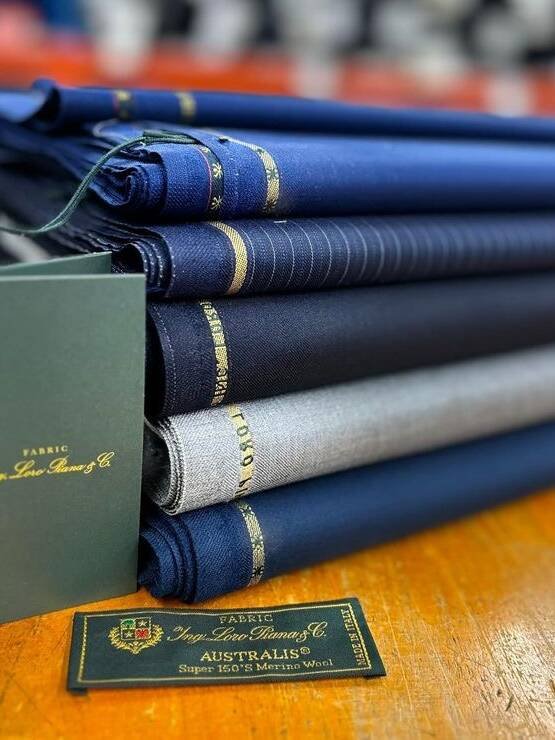
You will see fabrics labeled Super 100s, Super 120s, Super 150s, and up. The Super number refers to the fineness of the wool fiber, measured in microns. Higher numbers mean finer, softer, and more luxurious fabric, but also more delicate and prone to wrinkling.
- Super 100s, 120s: Durable, excellent for everyday business suits. Holds shape well, resists wrinkling, good value.
- Super 130s, 150s: Softer hand feel, great drape, ideal for special occasions and premium business wear. A sweet spot for most bespoke clients.
- Super 180s and above: Exceptionally luxurious and fine. Beautiful to the touch but delicate. Best reserved for suits worn occasionally, not as daily workwear.
Higher Super numbers are not automatically better. A Super 120s from a top mill will outperform a Super 180s from a mediocre one. The mill matters as much as the number.
Italian vs. English Mills
The two great traditions of suit fabric come from Italy and England, and each has a distinct character.
English mills (Scabal, Holland & Sherry, Dormeuil) tend to produce heavier, more structured fabrics with tight weaves. They excel at worsted wools, flannels, and tropical-weight cloths that hold their shape beautifully. English fabrics are ideal for business suits, formal wear, and garments that need to look sharp through a long day.
Italian mills (Loro Piana, Vitale Barberis Canonico, Ariston, Drago, Marzoni) lean toward softer, lighter, more fluid fabrics. Italian mills are renowned for innovative blends, luxury fibers like cashmere and vicuna, and warm-weather cloths that breathe exceptionally well. For a Miami climate, Italian lightweight wools are often the first choice.
At Bespoke By CB, we carry both traditions, from Scabal and Holland & Sherry on the English side to Loro Piana, Vitale Barberis Canonico, and Ariston on the Italian side, so you can match fabric character to your lifestyle and wardrobe needs.
3. Hand-Stitched Details: The Marks of Craftsmanship
Machine stitching is fast and consistent. Hand stitching is slower, more expensive, and visibly superior. A true bespoke suit will have handwork in the places where it matters most.
Lapel Roll
The lapel roll is the curve of the lapel as it folds back from the jacket front. A hand-padded lapel rolls naturally and softly, creating a three-dimensional shape that sits beautifully against the chest. A machine-pressed lapel looks flat and lifeless by comparison. When you button a two-button jacket, the lapel should roll gracefully, not crease sharply.
Buttonholes
A hand-stitched buttonhole has slightly irregular edges that look organic and refined. A machine-made buttonhole is perfectly uniform but looks flat and mass-produced. The highest level of craftsmanship is the surge bouton, a functional, hand-stitched buttonhole on the sleeve. If your tailor offers working sleeve buttonholes, that is a strong sign of bespoke-level construction.
Lining Attachment
In a true bespoke suit, the lining is attached by hand with a loose, even stitch that allows the jacket to move and breathe. Machine-attached linings are tighter and can cause the jacket to feel restrictive. The lining should have a slight give when you move your arms, not pull.
4. Fit Checkpoints: Where a Suit Must Fit Perfectly
A bespoke suit should fit perfectly in every dimension, but there are six critical checkpoints where fit is non-negotiable. If any of these are off, the suit is not done.
Shoulder
The shoulder is the structural foundation of the jacket. If the shoulder does not fit, nothing else can be fixed. The jacket shoulder should sit exactly at the end of your natural shoulder bone, not extending past it, and not falling short. There should be no divots, no bunching, and no gap between the collar and your neck.
Collar
The collar should hug the back of your neck snugly with no gap. A gap between the collar and your shirt collar is one of the most common fit problems, and it usually indicates a pattern issue that made-to-measure cannot fully correct. A bespoke pattern drafted from scratch accounts for your exact neck posture and shoulder slope.
Chest
The jacket chest should be clean and smooth, with no pulling at the button and no excess fabric pooling. When you button the jacket, there should be a slight break at the waist suppression, but the chest itself should look like it was sculpted around your ribcage, not borrowed from someone larger.
Waist
The waist should be suppressed to follow your natural waistline without feeling restrictive. A well-fitted waist creates the silhouette that makes a bespoke suit look distinctly different from off-the-rack. If the jacket gaps at the waist or feels boxy, the pattern was not drafted for your body.
Sleeve
Sleeves should follow the natural taper of your arm without excess fabric. The sleeve length should show roughly a quarter to half inch of shirt cuff. The sleeve should also follow the natural forward pitch of your arm, many off-the-rack sleeves hang straight down, which looks unnatural on most people.
Length
Jacket length should cover your seat and reach the base of your thumb knuckle. Too short and the suit looks modern but unbalanced. Too long and it looks like you borrowed your father's jacket. The right length creates visual proportion between your torso and legs.
5. Measurement Depth: Why 34+ Measurements Matters
This is one of the most overlooked differentiators in custom clothing. The number of measurements your tailor takes directly determines how well the suit will fit.
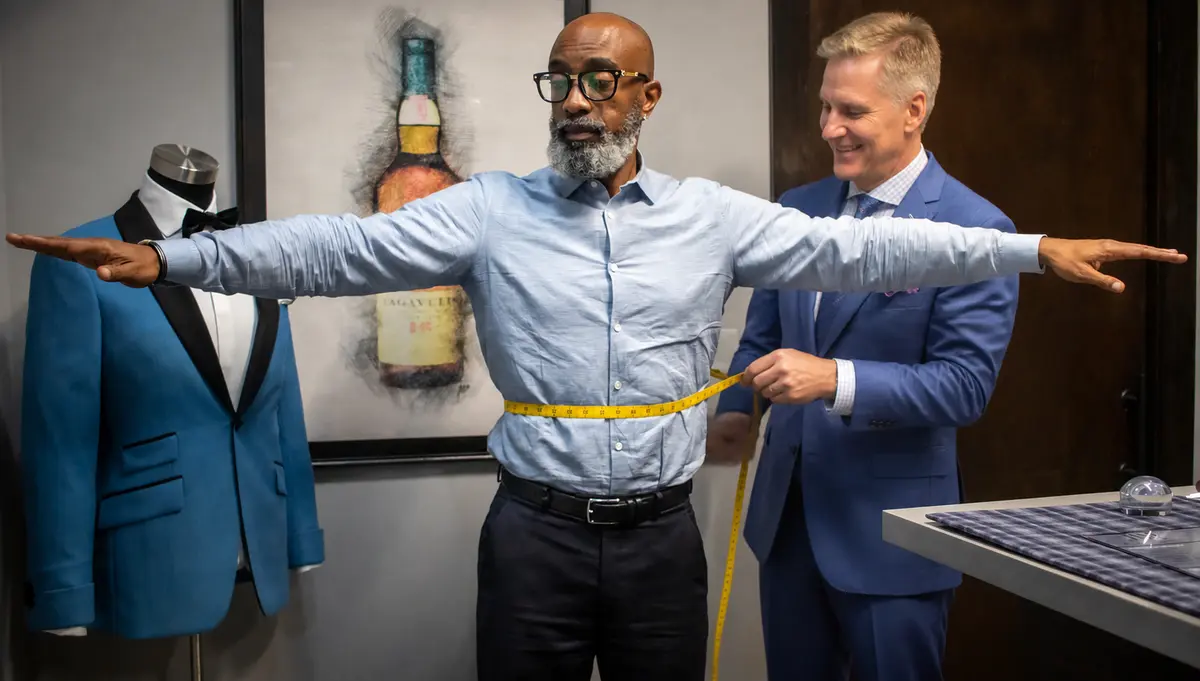
Most made-to-measure providers take 10 to 15 measurements: chest, waist, hip, shoulder, sleeve length, jacket length, neck, and a few others. They plug those numbers into a pre-existing block pattern and adjust it. The result is a suit that fits better than off-the-rack but still has the same underlying shape as hundreds of other suits.
True bespoke requires 34 or more individual measurements. This includes posture measurements, shoulder slope, scye depth, natural waist position, hip prominence, stance analysis, arm pitch, neck inclination, and dozens of other data points that capture the three-dimensional reality of your body.
Why does this matter? Because two men can have the same chest measurement and completely different body shapes. One may have a forward-head posture with sloped shoulders. The other may stand erect with square shoulders and a barrel chest. A 15-measurement pattern treats them the same. A 34+ measurement pattern does not.
See how Bespoke By CB's measurement process compares to typical made-to-measure providers.
6. Pattern Drafting: Individual vs. Modified Block
This is the core distinction between bespoke and made-to-measure, and it is where many buyers get misled.
Made-to-measure starts with a standard block pattern, essentially a template created for an average body, and modifies it based on your measurements. The adjustments are mathematical: your chest is two inches larger, so the pattern is widened. Your shoulders are narrower, so the pattern is trimmed. The underlying shape of the pattern never changes.
Bespoke drafts a completely new pattern from scratch for every client. No starting template. No block pattern. The pattern is drawn by hand on paper based on your 34+ measurements, your posture, your body asymmetries, and your style preferences. The result is a one-of-a-kind pattern that exists for you and no one else.
At Bespoke By CB, every pattern is hand-cut on paper by Christian Boehm himself, not generated by software. Once your pattern is created, it is kept on file permanently, so you can reorder from anywhere in the world without being remeasured.
7. Fittings: How Many and What Happens at Each
The fitting process is where the suit is refined from a constructed garment into something that fits your body perfectly. Here is what to expect at each stage.
First Fitting (Basted Fitting)
The first fitting typically happens when the jacket is partially constructed, basted together with loose stitches so adjustments can be made easily. You try on the jacket, and the tailor checks fit at every checkpoint: shoulder, collar, chest, waist, sleeve, and length. This is where structural issues are identified and corrected.
Second Fitting (Forward Fitting)
The second fitting occurs when the jacket is more fully constructed but still adjustable. The canvas is in place, the lapels are rolled, and the sleeves are attached. Fine-tuning happens here: minor waist suppression, sleeve length adjustments, collar adjustments. If the first fitting was correct, changes at this stage should be minimal.
Final Fitting (Delivery)
The final fitting is when the completed suit is delivered. The garment is fully finished, pressed, and ready to wear. Any last micro-adjustments are noted and recorded in your personal pattern file for future orders. At Bespoke By CB, Christian personally delivers your finished garments and ensures every detail is right.
8. Lining and Interior Details
The interior of a bespoke suit is where personality meets craftsmanship. These are the details that make the suit uniquely yours.
Functional Buttonholes (Surge Bouton)
Working buttonholes on the sleeve are a hallmark of bespoke tailoring. They serve no practical purpose for most wearers, but they signal that the sleeve was constructed by hand, not machine-pressed into shape. Functional buttonholes also allow you to roll up your sleeves slightly, which some clients love for a more relaxed look.
Personalized Lining
A bespoke suit can feature custom lining in any color or pattern you choose. From subtle contrasting silk to bold patterns that reflect your personality, the lining is the one place where you can be expressive without affecting the suit's outward appearance. Popular choices include navy with a subtle pattern, burgundy, forest green, and personalized monograms.
Pick Stitching
Pick stitching is the visible hand stitch that runs along the edge of the lapel, pocket flaps, and jacket edges. It is a subtle detail that signals handwork. Machine-made suits either lack pick stitching entirely or have a faux version that is clearly pressed on. Genuine hand pick stitching has slightly irregular spacing that looks intentional and crafted.
9. Button Quality: Horn vs. Plastic
This is a small detail that reveals a lot about the overall quality of a suit.
Horn buttons are cut from natural animal horn. Each button has a slightly different grain and color variation, making every set unique. Horn buttons are durable, feel substantial, and develop a natural patina over time. They are the standard on genuine bespoke suits.
Plastic buttons (sometimes called resin or corozo) are mass-produced, uniform, and lightweight. They are fine for shirts but have no place on a premium bespoke suit. If your tailor is using plastic buttons on a suit priced over $1,000, that is a corner being cut.
Other premium button options include mother-of-pearl (for shirts and some jackets), bone, and metal. For suits, horn is the benchmark.
10. Questions to Ask Your Clothier Before Committing
Before you invest in a bespoke suit, ask these questions. The answers will tell you whether you are dealing with a true bespoke tailor or a made-to-measure operation using bespoke terminology.
- "Do you draft a new pattern from scratch for each client, or do you modify an existing block pattern?", The answer should be: from scratch.
- "How many measurements do you take?", Look for 30+. Anything under 20 is made-to-measure.
- "Is the suit full canvas, half canvas, or fused?", For a bespoke price, it should be full canvas.
- "Are the lapels hand-padded?", They should be.
- "Are the buttonholes hand-stitched?", At minimum, the surgeon's cuff buttonholes should be.
- "How many fittings are included?", At least two, ideally three.
- "Who actually constructs the suit, your in-house tailors or a factory?", You want master tailors, not an assembly line.
- "Do you keep my pattern on file?", A true bespoke tailor will, so you can reorder without remeasuring.
- "What fabric mills do you carry?", Look for recognized names: Scabal, Loro Piana, Holland & Sherry, Vitale Barberis Canonico, Dormeuil.
- "Do you use horn buttons?", The answer should be yes.
If you are ready to experience true bespoke tailoring, book a consultation with Bespoke By CB. Christian Boehm will personally guide you through every decision, fabric, construction, fit, and finishing, and draft a pattern that exists for you alone.
Frequently Asked Questions
What is the most important feature to look for in a bespoke suit?
Canvas construction is the most critical indicator of quality. A full canvas suit will drape better, last longer, and mold to your body over time. If the suit is fused (glued), it is not true bespoke regardless of any other features.
How can I tell if a suit is full canvas?
The pinch test is the simplest method: pinch the fabric below the top buttonhole and gently pull the outer layer away from the inner layers. On a full canvas suit, you will feel three distinct layers separate. On a fused suit, the outer fabric and interfacing will stay glued together and will not separate. A reputable tailor should also be able to confirm construction type directly.
What Super number should I choose for my first bespoke suit?
For a first bespoke suit intended for regular wear, Super 120s to Super 150s is the sweet spot. These fabrics are fine enough to feel luxurious and drape beautifully, yet durable enough for frequent use. Reserve Super 180s and above for special occasion suits that will be worn less often.
How many fittings should a bespoke suit include?
A true bespoke suit should include at least two fittings, a basted fitting early in construction and a forward fitting closer to completion. Many tailors include a final delivery fitting as well. If your tailor offers only one fitting or none at all, you are likely looking at made-to-measure, not bespoke.
What is the difference between a hand-cut pattern and a computer-generated pattern?
A hand-cut pattern is drawn on paper by a tailor who considers your posture, body asymmetries, and style preferences in real time. A computer-generated pattern is produced by software from measurements entered into a system. Hand-cut patterns allow for the nuance and judgment that produce a truly individual fit. Computer patterns are efficient but produce the same underlying shape for every client with similar measurements.
Are horn buttons really better than plastic?
Yes. Horn buttons are cut from natural material, have unique grain patterns, feel more substantial, and develop a patina with age. Plastic buttons are uniform, lightweight, and mass-produced. On a bespoke suit, horn buttons are the standard, using plastic is a sign of cost-cutting.
How long does a bespoke suit last?
A full canvas bespoke suit with quality fabric and proper care can last 15 to 20 years or more. The canvas molds to your body over time, improving the fit. Fused suits typically last 2 to 5 years before the glue begins to degrade. The construction method is the single biggest factor in longevity.
Why does Bespoke By CB take 34+ measurements?
Because two men with the same chest size can have completely different body shapes. 34+ measurements capture posture, shoulder slope, arm pitch, scye depth, waist position, and dozens of other data points that a 10-to-15 measurement process ignores. The result is a pattern that is truly yours, not a modified template. Learn more about our process here.

