
The Problem Nobody Warns You About
Congratulations come first, because they are deserved. Whether your weight change came from a deliberate health effort, a demanding training program, a medical chapter, or simply a different season of life, you have earned the right to feel good about it. Then you open your closet, and reality lands: the suits that carried you through job interviews, weddings, boardrooms and celebrations no longer fit. The jacket shoulders sit wide, the trousers balloon at the waist, and the shirt you always trusted now billows at the chest.
Most style advice treats a wardrobe as a fixed asset. Buy quality, it says, and it will serve you forever. What that advice quietly assumes is that your body stays the same forever. When it does not, the tailored wardrobe you invested in becomes a museum of a previous self. The garments are still beautiful. They are simply no longer yours in the way they were on the day they were made.
This guide is a practical, respectful plan for what to do next. It covers how to assess what you own, what a tailor can and cannot rescue, how to decide between altering and replacing, and how to time new custom orders so your new wardrobe fits the body you actually live in today. Bespoke By CB has helped many Miami clients through exactly this transition, and the men who navigate it well follow the same sequence: sort honestly, alter selectively, replace strategically, and measure at the right moment.
Step One: Sort Your Wardrobe Honestly
Start by taking every tailored garment out of the closet and trying it on in front of a full-length mirror. Do this with good lighting and, ideally, with someone you trust giving feedback, because our own eyes normalize what we see daily. For each piece, sort it into one of four categories.
Category one: fits as is. Some garments will surprise you. A jacket with a fuller cut may now sit exactly right, or a pair of trousers that always felt snug may have become your new favorite. Weight change is not always a one-directional story, and pieces you rarely wore before may have a second life now.
Category two: close enough to alter. These are the candidates for a tailor's assessment. A good working rule: if the change needed is within roughly one to two sizes, or concentrated in one area such as the trouser waist, alteration is often realistic. If the jacket needs to come in more than that, the balance of the garment starts to fight you, and even a skilled tailor is working against the original cut rather than with it.
Category three: beyond practical alteration. Suits that are several sizes too large, garments whose proportions distort when taken in, or pieces whose value does not justify the work belong here. An altered garment that is technically smaller but visually wrong is not a savings. It is a delayed replacement.
Category four: sentimental or specialized. The tuxedo from your wedding, the jacket your father gave you, the suit you wore when you closed your first deal. These deserve their own decision, because value here is not measured in alteration math. Sometimes the answer is a careful preservation and a place of honor rather than a forced modernization.
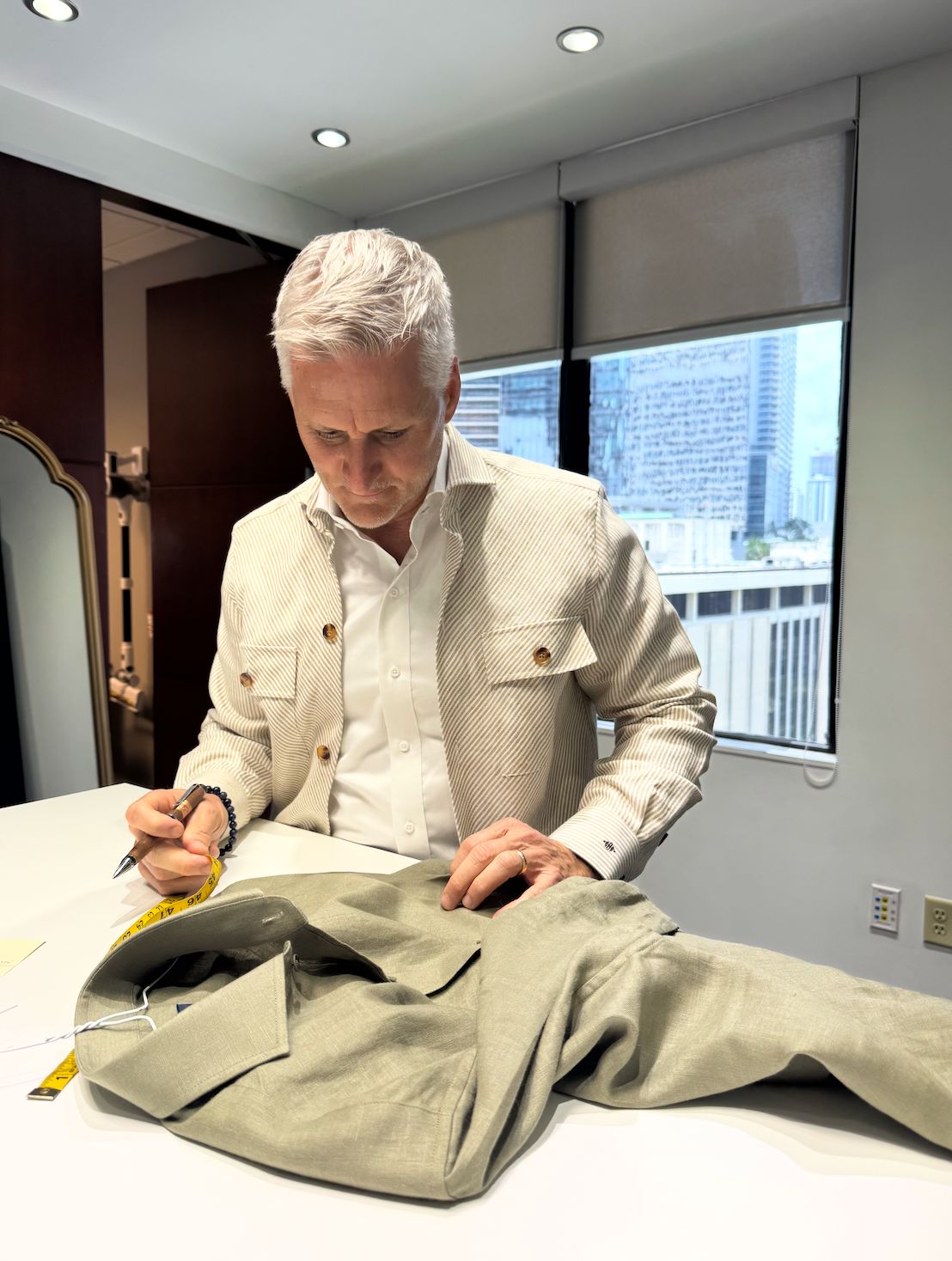
Write the category on a note for each garment as you go. The pile you are tempted to skip is category two, because it requires a professional opinion rather than a gut call. That is exactly the pile worth bringing to a tailor.
What a Tailor Can and Cannot Fix
Understanding the mechanics saves you money and disappointment. A garment is cut in three dimensions from panels designed to meet each other at specific points. When the body inside it gets smaller, the tailor can bring those panels closer together, but only up to the point where the seams, darts and balance of the original pattern allow a graceful result.
Jackets: where limits arrive fastest
The jacket is the hardest garment to take in successfully, because its architecture is interdependent. Taking in the side seams and center back is routine work, and shortening the sleeves from the cuff is straightforward. But the shoulders are the structural spine of the jacket. If the shoulder needs to be narrowed more than a modest amount, the tailor must take the jacket apart to the sleeve and shoulder, reset the sleeve, and re-cut the armhole. The cost rises steeply, the risk of a visibly altered silhouette rises with it, and for many off-the-rack jackets the construction makes even a competent shoulder job impossible. If your shoulders are the part that no longer fit, the honest answer is usually replacement, not reconstruction.
The lapel and chest tell a similar story. When the chest is taken in, the lapel roll can flatten or bow, and the collar can start to stand away from the neck. A collar that no longer sits is not a small problem; it is the fastest way for an altered jacket to look like an altered jacket.
Trousers: the friendlier patient
Trousers are far more forgiving, which is why they dominate the alterable pile. The waist can be taken in, the seat adjusted, and the legs tapered from thigh to hem. The catch is proportion: taking in the waist more than roughly two inches starts to affect the back pockets, the hip line and the drape through the seat. Excess fabric pinched out at the center back seam leaves a visible ridge. Waist suppression beyond that often requires recutting rather than adjusting, and recutting approaches replacement cost quickly.
Shirts: cheap to save, easy to overthink
Shirts are the least expensive tailored garments to alter, and shirt alterations are often worth it even when jacket alterations are not. Taking in the side seams and moving the darts restores a close fit for a modest price. The one thing a tailor cannot shrink is the collar and the shoulder yoke, so a shirt whose neck is now too large is finished as a dress shirt no matter what happens below the collar. Give the collars a hard look when you sort.
The fabric reserve problem
Every alteration needs spare cloth, and garments only have so much of it. Letting anything out requires seam allowance that many off-the-rack garments do not have, and matched patterns such as pinstripes and windowpanes multiply the difficulty of any recut. If your weight change went in the letting-out direction, check the seam allowances before you plan around a garment. Bespoke and made-to-measure garments often carry more generous allowances than ready-made ones, which is one of the quiet long-term advantages of custom clothing discussed in our guide on whether a custom suit is worth the investment.
How to Decide: Alter or Replace
With the tailor's limits understood, each garment in your alterable pile gets a decision. A simple framework keeps it honest.
- Cost versus value. Get a quote before committing. If alterations cost more than roughly a third of what an equivalent new garment would cost, and the garment is not sentimental, replacement usually wins.
- Structural versus cosmetic. Waist and seam changes are cosmetic and low-risk. Shoulder, armhole and collar work is structural and high-risk. Spend alteration money on cosmetic fixes; spend replacement money on structural mismatches.
- Age and condition. A ten-year-old suit with shine at the seat and seat wear at the sleeves is a poor candidate for investment. Cloth has a lifespan, and our suit care guide covers the signs of a garment nearing the end of it.
- Role in your life. Your interview suit, your funeral suit and your favorite warm-weather jacket deserve reliability. A backup blazer you wear twice a year can tolerate imperfection.
One more principle deserves emphasis: do not alter everything at once. Alter two or three pieces first, live with them for a couple of weeks, and see how the results feel. A tailor's first pass on a significantly changed body is also a diagnostic exercise, and what you learn from the first batch makes every later decision smarter.
Timing: When to Order New Custom Clothing
Here is the question every motivated man asks too early: can I just replace everything now with custom? The honest answer is that it depends on whether your weight has stabilized, and only you and time can answer that. What we can tell you is how to sequence the decision so you are never wasting money.
If your measurements are still moving
When weight is actively changing, hold off on major custom orders. A custom suit takes four to six weeks to make, and a wardrobe built on measurements that shift by the time of delivery starts its life already outdated. The interim strategy is alteration and thrift: have a few existing garments taken in to bridge the gap, accept that the bridge is temporary, and keep wearing clothes that fit reasonably rather than perfectly. Comfort and confidence during a transition matter more than optimization.
This is also the moment for small, quick purchases rather than large ones. Shirts, knitwear and trousers adapt to an in-between body better than structured jackets. Save the suits for stability.
Once your measurements have settled
When your weight has been stable for a few months, that is the moment to invest. Start with a full measurement session rather than reusing old numbers, because weight change affects proportions a tailor would never guess from your previous card: posture, shoulder slope, chest-to-waist drop and seat all shift, not just circumference. Bespoke By CB takes a fresh set of more than thirty measurements for exactly this reason, and clients rebuilding after weight change are the population where fresh measurements matter most. If you are curious what the session involves, our walkthrough of the custom suit fitting process in Miami covers it step by step.
Then order in priority order: the one suit you will wear most, then the shirts, then the second jacket, then the specialty pieces. A deliberate sequence means the first garment arrives while you still have a working interim wardrobe, and no single order becomes a rushed, high-stakes event.
The Miami heat factor
If you are rebuilding in South Florida, fabric choice deserves extra attention in the replacement plan. A body that has changed may run warmer or cooler than it used to, and Miami's climate punishes heavy cloth regardless. Lightweight wools, linen blends and open-weave fabrics are the foundation of a comfortable tropical wardrobe, and a garment you avoid wearing because it is hot is as useless as one that does not fit. Discuss how the garment should breathe before you discuss how it should look.
What Replacement Actually Costs
Rebuilding is less expensive than most men fear, because you are not replacing everything at once and you are not guessing anymore. Custom suits at Bespoke By CB start at $1,299, custom sport coats and blazers start at $1,199, and custom shirts start at $240. Against those numbers, the math of the alter-or-replace framework becomes concrete: a garment that needs $400 of structural alteration against a well-preserved $1,199 jacket is a judgment call, while $400 of structural work on a worn $400 ready-made jacket is not.
Compare the total honestly across the pile. Most men rebuilding after weight loss find that a handful of alterations on shirts and trousers, plus two or three strategic custom replacements, covers ninety percent of their real wardrobe needs. The rest of the closet was aspirational weight before the change and remains aspirational after it.
How Bespoke By CB Helps You Rebuild
Bespoke By CB has walked many Miami men through this exact transition, and the service is built around it. Bring your existing garments to a consultation and Christian will assess them with you piece by piece: what can be altered, what should be preserved, and what is worth replacing in what order. There is no pressure to replace everything, because the goal is a wardrobe you trust, not an invoice.
From there, the rebuild follows the custom process you would use for any garment: a fresh measurement session that respects how your body has changed, fabric selection weighted for South Florida weather, and a fitting cycle that catches the fit while it is still cloth and thread. Custom construction also builds in seam allowances that ready-made garments skip, which means the next time life changes your body, your wardrobe can follow it for a modest alteration instead of a full replacement. That resilience is the real argument for custom clothing, and it is the reason clients who rebuild with us rarely have to rebuild the same garment twice.
You can book a wardrobe rebuild consultation here, or start smaller with a single shirt order to experience the fit before committing to a suit. Either way, the first appointment is an assessment, not a purchase decision.
Frequently Asked Questions
How much weight loss makes a suit unwearable?
There is no fixed number, because fit problems depend on where you carry the change and how the garment was cut. As a practical rule, a suit that is more than one to two sizes too large usually cannot be taken in gracefully, because the shoulders, chest and lapel balance distort before the tailor runs out of seam allowance. A suit that is close but not quite right is almost always rescuable. Try the jacket on and watch the shoulder line first: if the shoulder seam overhangs your shoulder, the garment is likely beyond economic alteration.
Can a tailor take in a suit jacket after weight loss?
Yes, within limits. Taking in the side seams, center back and waist suppression are routine, and sleeves can be shortened easily. The expensive and risky work is the shoulder: narrowing it requires removing the sleeve, recutting the armhole and resetting the sleeve, and on many jackets the result never looks fully original. If your shoulders are where the fit failed, plan on replacement rather than reconstruction, and put alteration budget into trousers and shirts instead.
How many inches can trousers be taken in at the waist?
Roughly two inches is the comfortable ceiling for a standard waist alteration. Beyond that, the back pockets start to crowd, the hip line distorts, and the center back seam accumulates a visible ridge. Larger reductions require recutting the trousers, which costs more and works best when the tailor has enough matched fabric. Take an honest look at how the seat and pockets sit after a pinch test before committing.
Should I alter my old clothes or buy new ones?
Use both, in that order. Alter the pieces that need cosmetic work only, such as shirt side seams and trouser waists, because that work is cheap and low-risk. Replace the pieces with structural mismatches, especially shoulders and collars. Get alteration quotes before deciding; when the quote exceeds about a third of the replacement cost for a non-sentimental garment, replacement wins. Most men end up altering shirts and trousers while replacing one or two suits and a jacket.
When should I order new custom clothing after losing weight?
Wait until your weight has been stable for a few months before ordering major custom pieces. A custom suit takes four to six weeks to make, and measurements taken mid-change can be obsolete at delivery. In the meantime, alter a few existing garments as a bridge and rely on adaptable pieces such as shirts and knitwear. Once you are stable, start with a fresh measurement session and order in priority order: your most-worn suit first, then shirts, then specialty pieces.
What happens to suits that cannot be altered?
You have several good options beyond the bin. Sentimental pieces can be preserved and stored properly rather than forced into a modern fit. Quality garments in good condition can be donated to organizations that dress men for job interviews, which is a genuinely useful second life for a suit. A skilled tailor can sometimes repurpose cloth from a beloved garment into accessories or smaller pieces. And occasionally a suit that no longer fits you fits someone in your life perfectly, which is the cheapest wardrobe upgrade they will ever receive.
Do I need new measurements even if I know my old ones?
Yes. Weight change moves more than circumference: posture, shoulder slope, chest-to-waist drop, seat and arm hang all shift, and none of them can be inferred from an old measurement card. A fresh session is the only way the new garments fit the body you have now rather than a scaled version of the body you had. Bespoke By CB remeasures from scratch for every rebuild client precisely because interpolated numbers are where fit problems are born.
How do I rebuild a wardrobe on a budget after weight change?
Sequence your spending instead of replacing the closet. Spend small on shirt and trouser alterations first, because those deliver immediate daily results. Then put your main budget into the one custom suit you will wear most, chosen in a versatile color and a breathable cloth for the Miami climate. Add a second jacket and more shirts only after the first order proves itself. Skip buying duplicate specialty pieces until your daily rotation is solid, and let the sentimental pieces wait in storage; preservation costs almost nothing and can be revisited anytime.
Is it worth taking sentimental garments to a tailor anyway?
It is worth the consultation even when it is not worth the alteration. A tailor can tell you honestly whether a wedding suit can be brought in without losing its character, and sometimes the answer is a compromise: preserve the suit as it is, and commission a new garment in its image using modern cloth and your current measurements. Bespoke By CB clients have done both, and the ones happiest five years later are the ones who made a deliberate choice rather than a default one.
A Closing Note on the Person in the Clothes
The wardrobe is the easy part. The harder part is adjusting to the reflection in the mirror, and no tailor can do that for you. What a tailor can do is make sure the outside matches the inside quickly, so you are not spending a single extra morning tugging at a waistband or buttoning a jacket that swallows you. Clothes that fit the body you have now are a form of respect for the work you did to get here, whatever that work was.
Start with the sort, bring the maybe pile to a professional, and let the rebuild happen in its own order. Bespoke By CB is in Miami when you are ready for the part that involves fresh measurements and cloth books, and the consultation starts wherever you want it to.
