The dinner party occupies a strange place in a man's wardrobe decisions. It is not a wedding, so nobody sends you a dress code card. It is not the office, so nobody expects the suit you wear to a client meeting. And yet the stakes are real: you will be seen up close, under warm indoor light, across a table, for two or three hours, often by people whose opinion of you quietly matters. The man who shows up in gym clothes insults the effort his host made. The man who shows up in a boardroom suit at a casual table can make the whole room feel underdressed. The sweet spot exists, and it is wider than most men think.
This guide lays out how to find it. The principles are the same whether you are the host or a guest, at home or at a restaurant, in a casual group of old friends or a formal evening with clients or in-laws. But the details shift, sometimes a lot. Below you will find how to read the invitation for dress code cues, how the host's outfit differs from a guest's, outfit formulas for every level of formality, fabric choices for South Florida evenings, and how Bespoke By CB builds dinner party wardrobes for Miami men who host and get invited in equal measure.
Read the Invitation Before You Read Your Closet
Every dinner party communicates its dress code, even when nobody writes one down. Four signals do most of the work: the venue, the occasion, the host, and the time of day.
Venue is the strongest signal. A dinner at someone's home is almost always one notch more relaxed than the same dinner would be at a restaurant, because the host controls the environment and wants comfort, not ceremony. A dinner at a private dining room, a steakhouse with tablecloths, or a members-only club tells you the room itself expects polish, and your outfit should rise with it. When a restaurant has a stated dress code, respect it as a floor, not a target: dress one degree above what the room demands, never below it.
Occasion sets the ceiling. A Saturday dinner with your college friends is casual no matter where you eat. A birthday dinner for a client's spouse, an engagement celebration, or a holiday table with extended family pulls the whole event upward. If the dinner marks something, the outfit should acknowledge it. If it is just food and conversation, dress for pleasant company, not a ceremony.
The host's own style is a cue most men ignore. If you know the host wears tailored clothing to brunch, plan on the room skewing dressed up and match that energy. If your host is a jeans-and-henley guy who happens to make extraordinary short rib, arriving in a three-piece suit will read as a costume, not a compliment. You want to look like you considered the evening, not like you were considered by a stylist.
Time of day mostly affects color and weight. Evening dinners tolerate and even reward darker, richer tones: navy, charcoal, deep green, burgundy. Midday dinners, especially outdoors, shift toward lighter trousers, softer jackets, and paler palettes. In Miami, where a 7 PM dinner in November still feels like early summer elsewhere, the color logic of evening dressing works fine, but the weight logic needs a subtropical adjustment, which we will get to in the fabric section.
The Host Dresses Differently From the Guest
This is the distinction most style advice skips, and it changes the whole calculation.
A host has a physical job. You will carry platters, reach across the table, pour wine, greet people at the door, and stand for long stretches. Your outfit needs to move, breathe, and survive a splash of sauce without ruining the evening. Structure survives hosting better than fragility: a well-cut jacket that does not bind at the shoulder, a shirt that looks intentional with the sleeves turned back, trousers with a little room through the thigh. Dark and mid-tone colors hide kitchen evidence better than cream or white. And skip anything that demands constant attention, a silk tie swinging into the gravy, pocket squares positioned at art-gallery angles, fussy cuffs. The host's polish should look inevitable, not effortful.
The host also sets the room's register. Your guests calibrate to you. If you host in a tailored jacket, the table comfortably rises with you. If you host in a t-shirt, nobody else can fix it. This is why the best hosting move is usually the elevated casual formula: a sport coat or refined overshirt, an open collar, well-fitted trousers or dark denim, shoes you would not mind being photographed next to. You look like the man who owns the table without looking like you are addressing a shareholders meeting.
The guest's job is different: honor the effort without overshadowing it. A guest should land one notch above the room's expected register. If the invitation said casual, arrive casual-plus, jacket or none depending on the group, but tailored. If the dinner is formal, a guest can go fuller formal than the host, because the host has practical limits and the guest does not. The one thing a guest should never do is out-dress the guest of honor. At a birthday dinner, the man being celebrated owns the room; your outfit should be remembered as good, not as the thing people talked about on the drive home.

Three Formulas That Cover Almost Every Dinner Party
Rather than a wardrobe of one-off outfits, think in tiers. Three formulas cover essentially every dinner invitation you will receive, and each one can be built from pieces you already own or should own.
Formula One: Elevated Casual
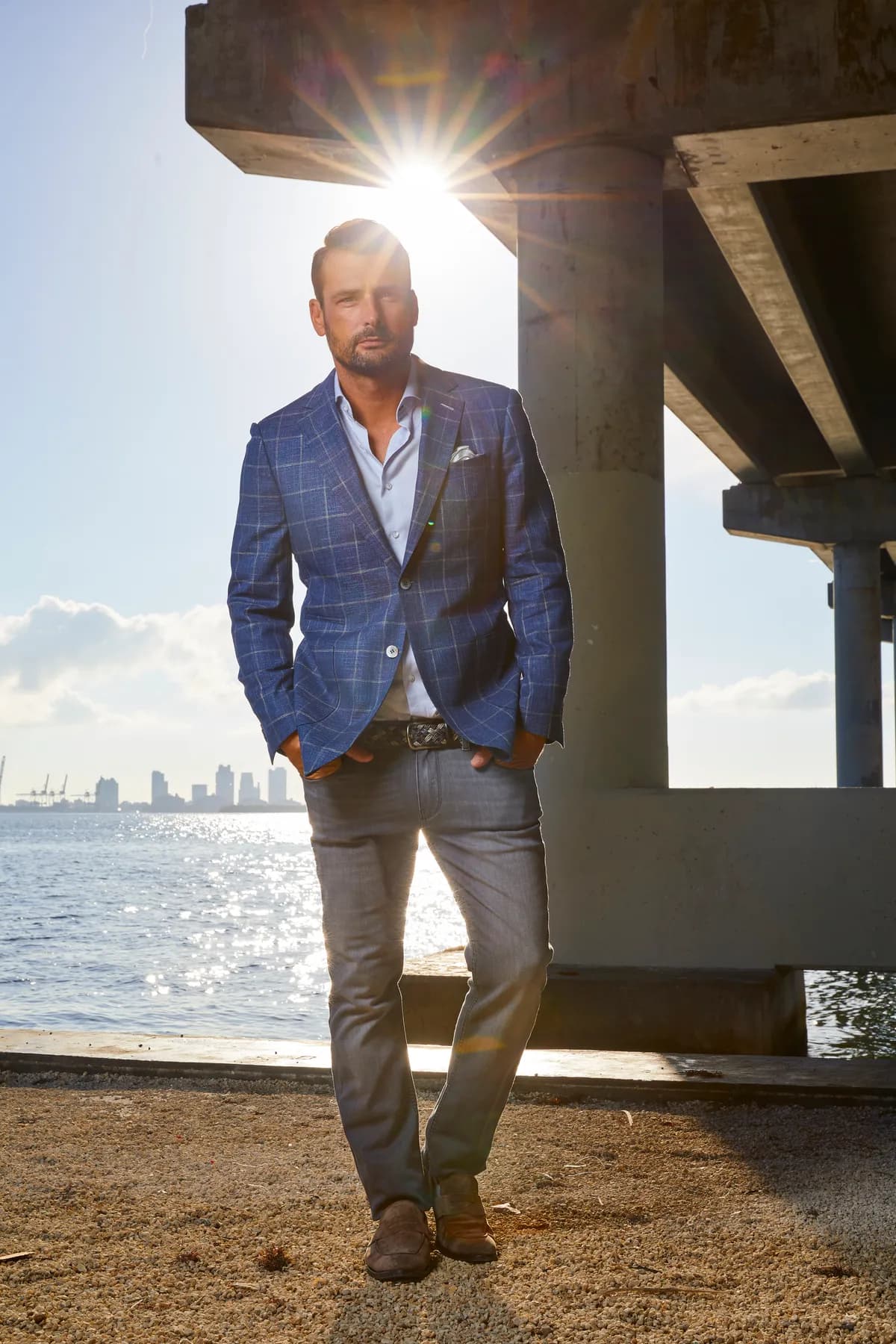
For home dinners with friends, weekend tables, and anything where the invitation says "no fuss." The core is a refined jacket over an open collar. A textured sport coat in navy, mid-grey, or a quiet pattern, over a fine-gauge knit, a crisp oxford, or a linen shirt worn open. Below the waist, tailored trousers or dark, well-fitted denim. Shoes stay leather: loafers, suede chukkas, or clean minimalist lace-ups. The tie stays home. This formula says "I respect your table and I intend to relax at it." Our guide to wearing a suit without a tie covers the open-collar balance in depth if you want to go a step sharper.
Formula Two: The Odd Jacket Dress-Up
For restaurant dinners, birthday tables, and hosts with serious style. This is where a blazer or sport coat earns its keep, now worn with more intention: a proper dress shirt, optionally a knitted or wool tie, and dress trousers rather than jeans. The jacket and trousers do not match, which keeps the look social rather than corporate. A pocket square adds festivity for the price of ten seconds of folding. This is the register of most celebratory dinners in Miami, polished enough for a Brickell dining room, relaxed enough that nobody mistakes you for the sommelier. Our cocktail attire versus business casual comparison breaks down exactly where this tier sits if the invitation language is ambiguous.
Formula Three: The Suit, Softened
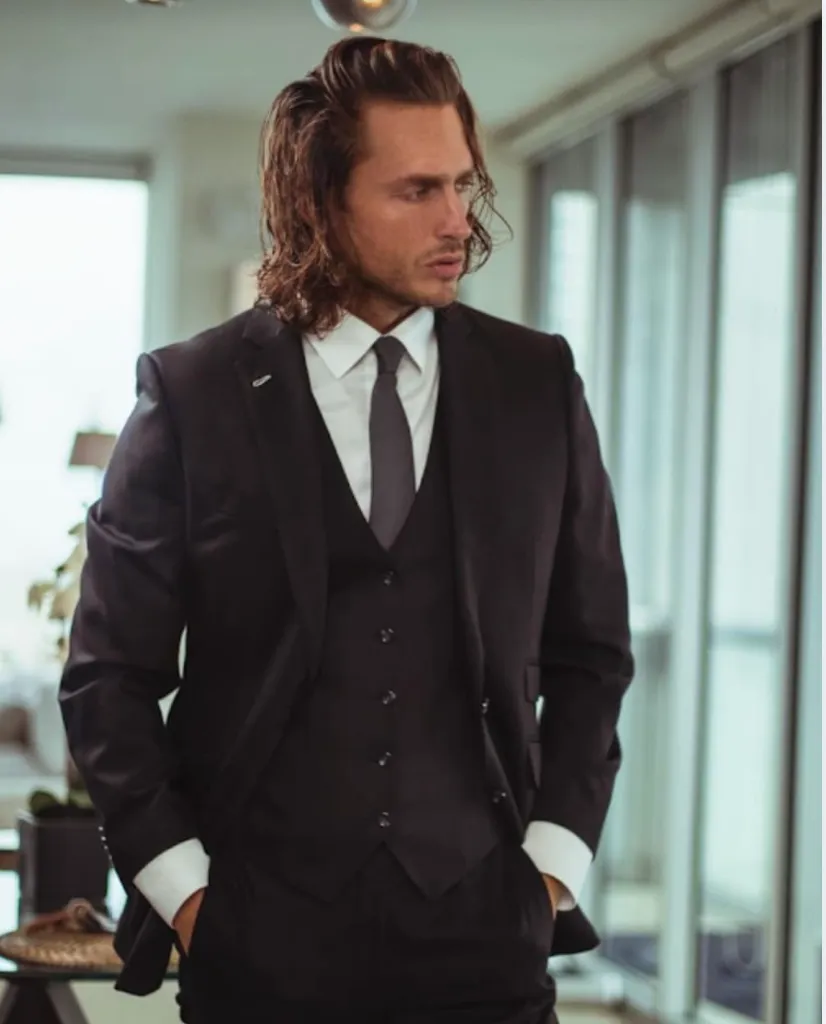
For formal dinners, private dining rooms, holiday tables, and dinners where you do not yet know the room. A dark suit, navy or charcoal, with a white or pale blue shirt, is the safest high-register choice in menswear because it never looks wrong, only adjustable. Wear it with a tie for the formal end of the evening and you are unimpeachable. Lose the tie, open the collar, and the same suit becomes a smart dinner look with nothing corporate about it. If the dinner is a genuine formal occasion rather than a business meeting, soften the styling deliberately: a textured shirt, a silk-knit tie, or a pocket square in place of the briefcase shoes. Our guide to dressing for business meals covers the boardroom version; the dinner party version is the same garment with all the office removed.

Fabric Choices for Miami Evenings
In most of the country, a November dinner party calls for flannel, tweed, and closed shoes without discussion. In South Florida, the calendar lies about the weather. A warm dining room, a kitchen sending heat into the rest of the house, and a table of twelve people will cook you in heavyweight cloth no matter what the month says.
The fix is fabric weight and weave, not formality. A jacket in a high-twist wool, a wool-linen blend, or a lightweight hopsack keeps you presentable at hour three when a heavy flannel jacket has you sweating through your shirt. Poplin and fine twill shirts breathe better than heavy oxford cloth under a jacket, and an undershirt in a light knit protects the shirt without adding bulk. Trousers in tropical-weight wool or a refined linen blend hold a crease through a seated dinner, which is exactly where pure linen gives up. None of this lowers the dress code. It just matches the cloth to the room, which is what Bespoke By CB does every day for Miami clients whose dinner invitations span penthouse terraces and backyard tables in the same week.
Color can stay wintery even when the fabric cannot. Deep navy, burgundy, forest green, and charcoal all read as evening-appropriate and photograph beautifully against a candlelit table, and none of them require a heavy cloth to make the point. The Miami mistake is not wearing dark colors in winter; it is wearing heavy dark fabrics to a table that is 78 degrees indoors.
What to Wear to a Restaurant Dinner Party
Restaurant dinners have their own physics. The room has a standard, the service has a rhythm, and you are in public, which raises both the formality floor and the need for quiet confidence.
Start with the restaurant itself. A jacket-required dining room tells you exactly what to do. A neighborhood bistro with communal tables tells you the formula is elevated casual, and a jacket is welcome but should be soft-shouldered and sit easily. The safest restaurant-dinner move, when you know nothing else, is Formula Two: odd jacket, dress shirt, dress trousers, leather shoes. It clears every dress-code floor short of black tie, and it never triggers the awkward moment of being seated in a t-shirt at a table with tablecloths.
Consider the logistics of the evening too. If there is a pre-dinner drink at a bar and a post-dinner walk, shoes and trousers need to handle pavement. If you are coming straight from the office, a quick conversion, tie removed, collar opened, pocket square added if you carry one, shifts a work suit into dinner mode without a wardrobe change. Many Bespoke By CB clients keep exactly this in mind when specifying their work suits: a cloth and shirt combination that reads as boardroom at 2 PM and as dinner guest at 8 PM is one of the highest-value moves in a custom wardrobe.
Hosting at Home: Practical Polish
Hosting changes your priorities. You will be on your feet more than anyone, in and out of the kitchen, hugging arriving guests, leaning over the table. Every one of those motions tests your outfit's construction.
Build the hosting look from movement outward. A jacket with a comfortable armhole and a soft shoulder lets you carry a tray without the whole garment riding up. Shirt sleeves that look good rolled to the forearm are worth more at a dinner table than French cuffs, however beautiful. Trousers should sit well standing and bending, which means a proper rise and a clean seat, not a slim-fit gamble. Dark and mid-tone colors forgive the splatter that cream does not. And shoes should be easy to slip on and off if your home is a shoes-off household, which many Miami hosts quietly prefer; a pair of refined loafers makes that transition graceful instead of awkward.
The best hosting outfits are quietly custom-minded even when they read as casual. A perfectly fitted dark knit with flat, clean seams, trousers hemmed without a break for the house, an overshirt or unstructured jacket cut close through the body: these details are invisible as details and visible as ease. You look like a man who is comfortable in his own home, because his clothes fit the man, and the man fits the night.
Accessories: The Volume Knob
Accessories are how you tune a single formula up or down without changing it. A tie is not a formality switch you must flip one way or the other; it is one of several dials.
The pocket square is the friendliest dinner party accessory: it adds festivity, it costs nothing in comfort, and it signals celebration. For hosts, a square in a casual puff fold looks intentional without looking guarded. A knitted silk tie softens a suit's business register while keeping the formality. A boutonniere or lapel pin belongs to celebratory dinners, engagement celebrations, birthdays, not ordinary Saturdays. Cufflinks stay in the drawer unless the shirt is French-cuffed and the evening is genuinely formal; at a home dinner they are asking a bit much of the table.
Watches, on the other hand, are almost always right. A modest watch under a cuff at a dinner table is a marker of a considered man, and the warm light of a dining room flatters leather straps and understated dials. Just avoid the oversized sports watch with a suit-jacket formula at formal tables; scale the strap to the outfit, not the other way around.
Common Dinner Party Mistakes
The mistakes are consistent enough to name. First, overdressing the room: a full business suit with a briefcase-grade tie at a casual backyard table makes you the evening's footnote, and it makes everyone else feel underdressed at what was supposed to be a relaxed night. Second, treating "come as you are" as a dare. It means the host does not want fuss, not that effort is unwelcome; one step up from your sofa clothes is the correct read. Third, fragility: wearing something so precious, light-colored, delicate, dry-clean-only, that you spend dinner protecting your outfit instead of enjoying your friends. Fourth, ignoring the kitchen heat factor in Miami, which cooks the overdressed host first and asks questions later. Fifth, new shoes at a standing-and-moving event; break them in, or wear the pair that already loves you back.
How Bespoke By CB Prepares You for the Dinner Party Circuit
This is where Bespoke By CB earns its place in your calendar. A dinner party wardrobe is not a shopping trip; it is a small set of garments cut to one body, your body, that recombines across every invitation an active social and professional life generates. During a custom consultation at our Miami showroom, we look at how you actually entertain and get entertained: the frequency of restaurant dinners, the hosting you do at home, the formal tables you cannot avoid, and the climate every one of them happens in.
From there, Bespoke By CB builds the tiered wardrobe this guide describes: a soft-shouldered sport coat in a breathable weave that carries your elevated casual evenings, an odd jacket and trouser combination that covers celebratory restaurant dinners, and a dark suit in a cloth light enough for South Florida that softens gracefully from formal to smart. Each shirt is cut to your collar and sleeve so the open-collar look is a design choice rather than a compromise, and every cloth is chosen with a Miami dinner table in mind, breathable under warm light, dark enough to forgive a sauce, and substantial enough to hold a crease from the first toast to the last pour. Custom garments starting at $1,299 for a suit or tuxedo, $1,199 for a sport coat or dinner jacket, $399 for trousers, and $240 for a shirt put a full dinner-party rotation within reach, and the fit consultation costs you nothing but an hour.
The result is that the question "what should I wear?" stops being a small anxiety before every invitation and becomes the easiest decision of your week, because the answer is already hanging in your closet, and it fits.
Frequently Asked Questions
What should a man wear to a casual dinner party?
A refined jacket over an open collar is the safest and most flattering answer. A textured sport coat in navy, grey, or a quiet pattern, over a fine-knit or oxford shirt worn open, with tailored trousers or dark, well-fitted denim and leather shoes. You can also skip the jacket entirely if the group is truly relaxed, but keep everything else tailored: a well-fitted shirt, clean trousers or dark jeans, and proper shoes. The goal is to look like you considered the evening without treating it like a ceremony.
Should the host dress up more or less than the guests?
The host should dress at or slightly above the register he wants the room to hold, but with more practical clothing than the guests. Guests can afford fragility; hosts cannot. A host who wants a polished table wears the jacket but in a comfortable cut, with sleeves he can roll and colors that forgive the kitchen. The host's outfit also sets the ceiling: guests calibrate to it, so a host in a t-shirt cannot ask the table for anything more.
Is a suit too formal for a dinner party?
It depends on the dinner, but usually no, provided you soften it. At a formal dinner, a private dining room, a celebration with clients or family, a dark suit is correct. At a casual home dinner, a full suit with a business tie can outclass the room; if you are unsure, wear the jacket as a separates look with different trousers, or wear the suit open-collar and swap the dress shirt styling for something more social. The suit itself is rarely the mistake; the office styling is.
Should you wear a tie to a dinner party?
Only at the formal end. A tie is appropriate for formal dinners, celebratory restaurant tables, and any dinner where the invitation or venue signals real polish. For most home dinners and casual restaurant meals, an open collar with a well-cut jacket reads as friendlier and more appropriate. If you like the formality a tie brings without the boardroom feel, choose a knitted silk or textured wool tie, which softens the register while keeping the formality.
What colors work best for a dinner party?
For evening dinners, dark and rich tones: navy, charcoal, deep green, burgundy, and chocolate brown all photograph beautifully in warm indoor light and signal evening without ceremony. For daytime or outdoor dinners, lighten the palette: cream, stone, pale blue, and light grey. In Miami, keep the colors seasonal but let the fabrics stay light; a deep navy in a breathable weave is a winter dinner answer that works at 78 degrees.
What shoes should I wear to a dinner party?
Leather, in a style matched to your formula. Loafers, suede or polished, cover everything from home dinners to smart restaurant tables and handle a shoes-off household gracefully. Clean minimalist lace-ups or suede chukkas suit the odd jacket formula. With a suit, wear proper dress shoes, oxfords or an elegant derby, and keep them well-conditioned, because a candlelit table is the most unforgiving light your shoes will ever face. Avoid athletic shoes and anything you would wear to run errands.
How do I dress for a dinner party in hot weather?
Choose cloth over color. Keep the evening palette but specify breathable fabrics: high-twist wool, hopsack, wool-linen blends, and poplin or fine twill shirts. Skip heavy flannels and thick oxford weaves, and consider whether the jacket is needed at all for a truly casual table. Trousers in tropical-weight wool hold a crease through a seated dinner better than linen. This is exactly the tradeoff Bespoke By CB solves in a Miami wardrobe consultation: your formal register does not need to come with a weather penalty.
Can I wear the same outfit as host and guest?
The pieces overlap, but the emphasis differs. A host builds from movement outward: softer construction, roll-ready sleeves, darker forgiving colors, comfortable shoes for hours on your feet. A guest optimizes for appearance across the table: sharper structure, the option of a tie or pocket square, and less concern for kitchen survival. The same sport coat serves both roles; only the styling underneath changes. A versatile custom wardrobe is designed for exactly this kind of recombination, which is why it outperforms a closet of single-occasion outfits.