Most men own a few suits and a drawer full of ties but have never been taught how to pair them. The result is a closet full of options and nothing that looks right together. This guide breaks down the rules I have used for decades to help clients build outfits that look intentional, not random.

Start With the Suit, Not the Tie
The suit is the foundation. The tie is the accent. You should always pick the suit first, then the shirt, then the tie. Working backwards from the tie leads to outfits that feel forced.
When you know what suit you are wearing, the field of compatible ties narrows itself. A navy suit opens up burgundy, green, gold, and patterned ties in those color families. A grey suit works with almost anything. A brown suit wants earth tones. The suit tells you what colors are available.
Color Pairing Rules by Suit Color
Navy Suits
Navy is the most versatile suit color in menswear. It pairs with:
- Burgundy, the classic combination. Deep red against navy reads confident and traditional.
- Green, forest green or olive works beautifully, especially in fall and winter.
- Gold, a gold tie with a navy suit is a power combination for formal settings.
- Blue, a lighter blue tie against navy creates a monochromatic look that works when the tones are different enough.
- Patterned ties, stripes, paisleys, and textures in any of the above colors.
Grey Suits
Grey is the second most versatile suit color. It is the neutral canvas of menswear.
- Light grey suit, pairs with navy, burgundy, green, and brown ties. Avoid black ties with light grey unless you are attending a funeral.
- Medium grey suit, the most flexible. Almost any tie color works. Navy and burgundy are the strongest choices.
- Charcoal suit, reads more formal and authoritative. Pair with burgundy, deep green, or a silver and navy striped tie.
Brown Suits
Brown suits are having a moment. They pair best with:
- Olive green, the natural pairing. Earthy and sophisticated.
- Mustard or gold, warm tones that complement brown.
- Navy, the contrast between warm brown and cool navy is striking.
- Burgundy, works well with medium brown suits.
Blue Suits (Lighter Than Navy)
A mid-blue suit is less formal than navy but more interesting. Pair with:
- Burgundy or rust, warm contrast against cool blue.
- Brown, a brown knit tie with a blue suit is one of my favorite combinations.
- Green, works when the green is muted, not bright.
Pattern Mixing: The Three Rules
Most men are afraid to mix patterns. The rules are simpler than you think.
Rule 1: Vary the Scale
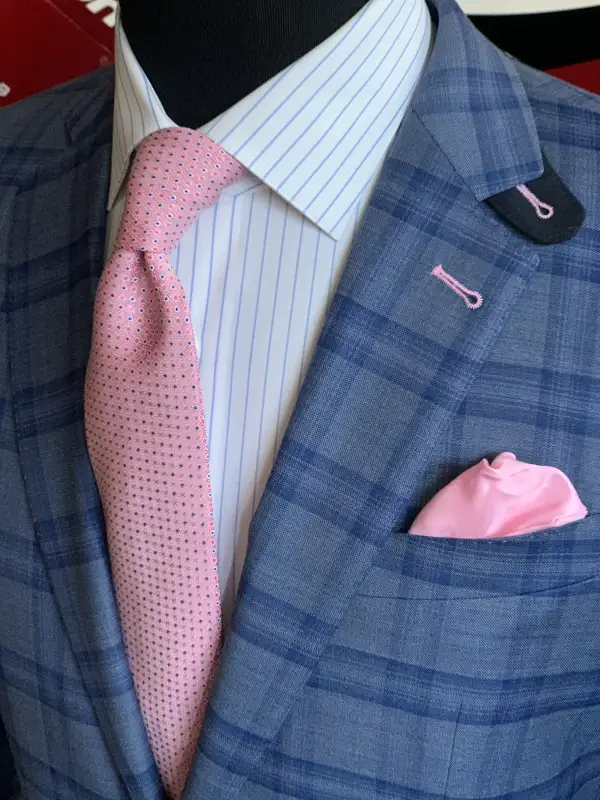
If your suit has a large windowpane check, your tie should have a small pattern. If your suit has a subtle pinstripe, your tie can have a larger pattern. Two patterns of the same size fight each other visually.
- Large suit pattern + small tie pattern = works
- Small suit pattern + large tie pattern = works
- Large suit pattern + large tie pattern = does not work
- Small suit pattern + small tie pattern = depends, but risky
Rule 2: Keep the Shirt Simple
When your suit and tie both have patterns, your shirt should be solid. A patterned suit, patterned tie, and patterned shirt is three patterns too many. The shirt is the breathing room between the suit and the tie.
If your suit is solid, you can pattern both the shirt and the tie, but keep their scales different. A striped shirt with a paisley tie works. A striped shirt with a striped tie can work if the stripes are very different in width and direction.
Rule 3: Connect Colors, Not Patterns
Your tie does not need to match your suit pattern. It needs to share a color with something in the outfit. A navy suit with a subtle glen check pairs with a burgundy tie that has navy accents. The navy in the tie connects to the suit color, even though the patterns are different.
Texture Matching
Texture is the element most men ignore, and it is the one that separates a good outfit from a great one.
- Smooth silk ties, pair with smooth wool suits and worsted fabrics. A silk tie with a gabardine suit looks sharp and formal.
- Knit ties, pair with textured suits like tweed, hopsack, or flannel. A wool knit tie with a Donegal tweed jacket is a cold-weather classic.
- Grenadine ties, the most versatile textured tie. Works with both smooth and textured suits. A navy grenadine with a grey suit is one of the most elegant combinations in menswear.
- Linen ties, pair with linen or cotton suits in summer. A linen tie with a wool suit looks out of place.
The general rule: match the formality and weight of the tie to the suit. Heavy fabrics go with heavy fabrics. Light with light. Smooth with smooth. Textured with textured.
How Long Should a Tie Be?
When you stand naturally with your trousers at their intended waist height, the tip of a conventional necktie should finish around the top of the waistband, near the middle of the belt buckle if you wear a belt. Treat this as a practical visual guide rather than a measurement to force regardless of your proportions. A tie that stops high above the waistband can look unfinished; one that hangs well below it creates an unnecessarily long vertical line.
Set the length with your actual shirt and trousers on. Tie the knot, settle it at the collar and check the result while standing normally, not stretching upward toward the mirror. If the front blade finishes too high or low, retie it with a different starting balance between the two ends. A larger knot uses more fabric, so changing from a four-in-hand to a fuller knot may require another adjustment.
The narrow blade should sit behind the front blade. If you cannot achieve a useful front length without the narrow end showing or the knot becoming awkward, try a different tie length rather than stuffing excess fabric into the waistband. Taller men may need a longer tie, while a shorter tie can suit a shorter torso. A tie bar can keep the blades together, but it does not correct a tie that is the wrong length. Bespoke By CB can assess these proportions with your suit and shirt during a fitting.
Frequently Asked Questions
Should my tie match my pocket square?
No. Your pocket square should complement the outfit, not match the tie exactly. Pick up a secondary color from the tie or the suit in the pocket square instead.
What tie width works with my suit?
Your tie width should roughly match your lapel width. If your lapels are 3 inches, your tie should be between 2.75 and 3.25 inches. Narrow lapels with wide ties look unbalanced.
How many ties do I actually need?
For a working wardrobe of three suits, you need about eight to ten ties. That gives you enough variety to rotate without repeating the same combination too often. Quality over quantity, two great ties are better than ten mediocre ones.
Ready to build a suit and tie wardrobe that actually works together? Book a consultation at Bespoke By CB and we will help you build a cohesive collection from the ground up.